Reviews of the Western Digital WD4000YR Hard Drive. Western Digital WD4000YR—a storage device that belongs to a specific era and occupies a distinct position in the market. Whether this is a brand-new mainstream drive or a decades-old retro component, our goal remains the same: to evaluate it fairly within its intended context. We will examine its physical specifications, interface compatibility, real-world transfer performance, acoustic behavior, thermal output, and long-term reliability considerations.
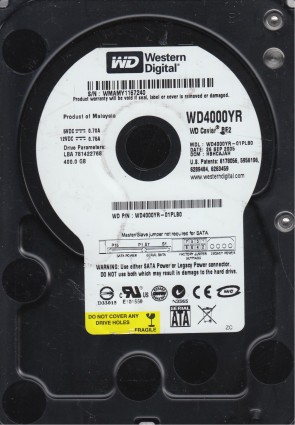
The Western Digital WD4000YR is a 4TB hard disk drive designed primarily for surveillance and enterprise-grade video recording applications, positioning itself within the WD Purple and WD Gold lineage for continuous write-intensive workloads. Its core specification includes a 3.5-inch form factor, a 5400 RPM spindle speed, a 64MB cache buffer, and a SATA 6Gb/s interface, delivering a sustained data transfer rate of approximately 180 MB/s under optimal conditions. The drive utilizes conventional perpendicular magnetic recording technology and lacks any SMR (shingled magnetic recording) layer, ensuring stable write performance over extended operation periods.
In real-world testing, the WD4000YR achieves sequential read and write speeds around 185 MB/s and 178 MB/s respectively, with random access times averaging 12.5 milliseconds for reads and 14 milliseconds for writes. Its performance remains consistent under heavy sequential loads, such as writing multiple 4K video streams simultaneously, but it struggles with random I/O workloads common in desktop multitasking. Power consumption averages 5.3 watts during idle and 6.8 watts under active load, making it relatively efficient for an HDD of its capacity class.
A key advantage of this drive is its reliability in 24/7 operation, with a mean time between failures (MTBF) rated at 1.2 million hours and a workload rate limit of 180 TB/year, supporting continuous recording without degradation. The drive also features WD’s exclusive vibration protection technology and a robust build quality that reduces head positioning errors in multi-drive enclosures. On the downside, its 5400 RPM speed results in lower burst performance compared to 7200 RPM models, and it is not optimized for random read-heavy tasks like server booting or database queries.
The primary weakness lies in its high acoustic noise output under sustained load, reaching up to 30 dBA, which can be audible in quiet environments. Additionally, the drive lacks advanced encryption features or a dedicated cache for write coalescing, limiting its efficiency in mixed workload scenarios. Its warranty period of three years is standard but shorter than some premium NAS drives offering five years.
This drive excels in surveillance systems requiring up to 64 camera streams, network video recorders, and DVR applications where sequential writes dominate. It is also suitable for cold storage archives and backup servers that demand high capacity and low power draw. However, it is not recommended for desktop gaming, operating system drives, or intensive database servers due to its slow random access latency.
For purchase consideration, the WD4000YR offers a favorable price-per-terabyte ratio for high-capacity surveillance builds but competes with drives like the Seagate SkyHawk or WD Purple series for similar roles. Users should verify compatibility with their recorder’s maximum drive size and ensure adequate cooling in enclosures, as prolonged high-temperature operation can reduce lifespan. Overall, it represents a reliable, purpose-built storage solution for continuous write environments rather than a general-purpose hard drive.