Reviews of the Western Digital WD3000JB Hard Drive. Western Digital WD3000JB—a storage device that belongs to a specific era and occupies a distinct position in the market. Whether this is a brand-new mainstream drive or a decades-old retro component, our goal remains the same: to evaluate it fairly within its intended context. We will examine its physical specifications, interface compatibility, real-world transfer performance, acoustic behavior, thermal output, and long-term reliability considerations.
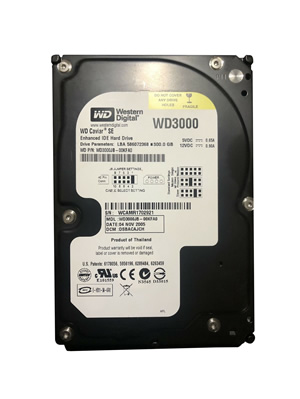
The Western Digital WD3000JB is a 3.5-inch hard disk drive from the early 2000s, positioned as a high-capacity storage solution for desktop computers. With a 300GB capacity, it was designed for users needing substantial data storage for documents, multimedia files, and general computing tasks, leveraging the then-advanced Enhanced IDE (EIDE) interface. Its form factor and connection standard made it a direct replacement for earlier, smaller drives in standard desktop systems.
Core specifications include a spindle speed of 7200 RPM, a 8MB cache buffer, and an Ultra ATA/100 interface. The drive features a seek time of approximately 8.9 milliseconds. These specs positioned it as a performance-oriented model within the WD Caviar series, offering faster data access and transfer rates compared to the 5400 RPM drives common at the time. The 300GB capacity represented a significant upgrade for users migrating from 80GB or 160GB drives.
In terms of performance, the WD3000JB delivered consistent sequential read and write speeds averaging around 40-45 MB/s, which was competitive for its generation. While far slower by modern standards, its 7200 RPM spindle and 8MB cache provided noticeable improvements in boot times and large file transfers compared to its predecessors. The drive operated at a moderate noise level, typically audible in quiet environments, and generated a moderate amount of heat due to its higher rotational speed.
A key advantage of the WD3000JB was its reliability and robust build quality, with many units proving durable over extended use. Its generous cache helped mitigate performance dips in multi-tasking scenarios. However, the drive suffers from a major limitation: its obsolete IDE interface, which offers significantly lower bandwidth than SATA and lacks modern features like Native Command Queuing. Additionally, its mechanical design and modest performance cannot handle the throughput demands of modern operating systems or software, and it is prone to failure due to age-related wear.
The primary drawback is its incompatibility with modern motherboards, requiring a legacy IDE controller or adapter. The drive’s capacity is also small compared to contemporary SSDs and HDDs. Furthermore, it is relatively fragile and energy-inefficient by today’s standards. For use in daily computing, its slow random access times make it unsuitable for running an operating system efficiently.
This drive is best suited for retro computing enthusiasts building or restoring legacy systems from the early 2000s, such as Windows 98 or Windows XP machines. It can also serve as secondary storage in old hardware for archiving era-specific software or games. Its primary buyer should be someone seeking period-correct components for vintage computer projects, not for modern, high-speed storage needs.
Given its age, a used WD3000JB can often be found at very low prices, typically under $10. However, the risk of failure is high. For purchase, only consider units with verified, good health status. If you need a functional IDE drive, a new-old-stock unit is preferable but rare. For most users, modern SATA drives or IDE-to-SATA adapters paired with a contemporary SSD are vastly superior and more reliable. The WD3000JB is a historical artifact best appreciated for its role in desktop storage evolution, not as a practical daily driver.