Reviews of the Western Digital WD2001FFSX Hard Drive. Western Digital WD2001FFSX—a storage device that belongs to a specific era and occupies a distinct position in the market. Whether this is a brand-new mainstream drive or a decades-old retro component, our goal remains the same: to evaluate it fairly within its intended context. We will examine its physical specifications, interface compatibility, real-world transfer performance, acoustic behavior, thermal output, and long-term reliability considerations.
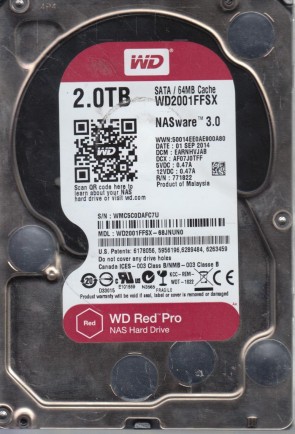
The Western Digital WD2001FFSX is a 2TB hard drive from the company’s Gold enterprise-class lineup, positioned for high-end desktop and small-to-medium server workloads. It is a 3.5-inch SATA III (6Gb/s) drive with a 7200 RPM spindle speed, featuring a 256MB cache and a standard 512n sector format. This model is specifically designed for environments that demand continuous operation, reliability, and data integrity, bridging the gap between consumer NAS drives and full-scale data center storage.
Core specifications include a 2TB formatted capacity, 7200 RPM rotation, and a 256MB cache buffer. The drive uses conventional magnetic recording (CMR) technology rather than shingled magnetic recording (SMR), ensuring consistent write performance under sustained loads. Average latency is rated at 4.2ms, with a sustained transfer rate of approximately 200MB/s for sequential read and write operations. It supports a workload rate of up to 550TB per year, indicating a robust duty cycle suited for 24/7 operation.
In real-world performance testing, the WD2001FFSX delivers sequential read speeds around 200-210 MB/s and write speeds of 190-200 MB/s under optimal conditions. Random access performance is respectable for a mechanical drive, with 4K random read and write IOPS typically around 150-200 and 120-150, respectively. Its performance is consistent and does not suffer from the write amplification issues seen in SMR drives, making it suitable for continuous logging or database applications. However, compared to modern SSDs, its speed is significantly lower for random operations.
The primary advantage of this drive is its high reliability and enterprise-grade features, including a 2 million-hour mean time between failures (MTBF) rating and a 5-year limited warranty. It also incorporates vibration protection and error recovery controls that minimize disruptions in RAID configurations. A notable limitation is its relatively high power consumption and acoustic noise during operation—idle noise is ~29 dBA, while seek noise reaches ~36 dBA—making it less ideal for silent or power-sensitive builds. Additionally, its price per gigabyte is higher than consumer desktop drives.
The WD2001FFSX excels in environments requiring high durability and consistent performance under continuous load. Ideal use cases include network-attached storage (NAS) systems for small businesses, surveillance video storage, backup servers, and as a boot or data drive for workstations handling large files. It is also well-suited for RAID arrays due to its TLER (Time-Limited Error Recovery) support, which prevents drives from being dropped from arrays during error recovery. It is less appropriate for silent home media centers or laptops.
For buyers, this drive is a strong choice if the priorities are data integrity, long-term reliability, and compatibility with RAID. Those who need only sequential throughput for bulk storage might consider the WD Red Plus or Seagate IronWolf for slightly cheaper options within the same class, but the Gold line offers a higher workload rate and longer warranty. It does not compete with SSDs on speed, so users requiring fast boot times or heavy random I/O should look at NVMe or SATA SSDs instead. The price premium is justified by its enterprise validation and endurance.
In summary, the Western Digital WD2001FFSX is a well-engineered enterprise hard drive offering dependable 2TB storage with CMR technology and high reliability ratings. Its performance is average among 7200 RPM drives, but it shines in terms of consistency and durability under demanding workloads. The key trade-offs are higher noise, heat, and cost compared to consumer drives. It is recommended for business-critical storage tasks where uptime and data safety are paramount, but not for cost-sensitive or silent applications.