Reviews of the Western Digital WD1001FAES Hard Drive. Western Digital WD1001FAES—a storage device that belongs to a specific era and occupies a distinct position in the market. Whether this is a brand-new mainstream drive or a decades-old retro component, our goal remains the same: to evaluate it fairly within its intended context. We will examine its physical specifications, interface compatibility, real-world transfer performance, acoustic behavior, thermal output, and long-term reliability considerations.
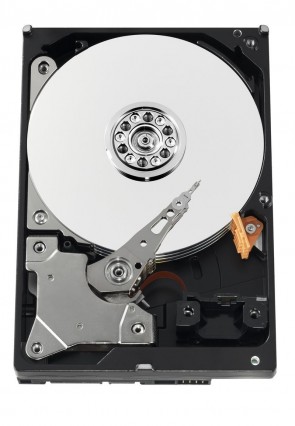
The Western Digital WD1001FAES is a 1TB hard disk drive designed for enterprise-class nearline storage, positioned between consumer-grade desktop drives and high-end SAS models. It features a 3.5-inch form factor, a SATA 3.0 Gb/s interface, and a spindle speed of 7200 RPM, with 64MB cache and a platter density that supports sustained transfer rates up to approximately 120 MB/s. This drive is intended for applications requiring reliable, high-capacity bulk storage with extended duty cycles.
Core specifications include a formatted capacity of 1,000,204 MB, an average latency of 4.20 ms, and a seek time of 8.9 ms (read) and 10.9 ms (write). The drive employs a dual-stage actuator and RAFF (Rotary Acceleration Feed Forward) technology to compensate for vibration, making it suitable for multi-drive enclosures. Power consumption is rated at 8.4W during read/write operations and 6.1W at idle, with an acoustic output of 32 dBA idle and 36 dBA seek.
In performance benchmarks, the WD1001FAES delivers sequential read and write speeds of around 105-115 MB/s depending on the zone, with random access times typically under 13 ms for 4K workloads. Its sustained throughput is consistent across the platter due to advanced formatting, and it handles multi-user environments adequately for non-sequential tasks. However, it does not match the random IOPS of modern SATA SSDs or higher-end enterprise HDDs with faster interfaces.
Key advantages include its robust build quality with a 1.2 million hours MTBF rating, a five-year limited warranty, and excellent reliability under 24/7 operation. The drive also features TLER (Time-Limited Error Recovery), which prevents drive dropouts in RAID arrays. On the downside, its 3.0 Gb/s SATA interface can become a bottleneck in high-throughput arrays, and its power consumption and heat output are higher than contemporary 5400 RPM drives, making it less efficient for non-intensive storage.
Weaknesses include relatively limited capacity compared to modern 4TB+ HDDs, and the absence of advanced power-saving features or encryption found in some newer enterprise drives. The random write performance is notably slower than SSD or high-RPM SCSI alternatives, making it unsuitable for heavy transactional workloads. Additionally, its noise levels can be noticeable in quiet home environments.
This drive is best suited for nearline storage in RAID arrays, NAS systems, or servers where high reliability and moderate speed are required, such as backup archives, media streaming, and file serving. It is not recommended for operating system drives, heavy database servers, or real-time video editing due to its random access limitations. For cost-sensitive deployments needing dependable bulk storage, the WD1001FAES remains a solid choice within its era’s product range.
For modern buyers, it is advisable to consider faster 7200 RPM drives with SATA 6 Gb/s interfaces or SSDs for primary storage, but refurbished or used WD1001FAES units can still serve as low-cost expansion for archival purposes. Evaluate the trade-off between capacity per dollar and performance; if consistent read/write speeds and RAID compatibility are priorities, this drive remains functional but technologically dated. Verify compatibility with your controller and case cooling before purchase.