Reviews of the Seagate ST960815A Hard Drive. Seagate ST960815A—a storage device that belongs to a specific era and occupies a distinct position in the market. Whether this is a brand-new mainstream drive or a decades-old retro component, our goal remains the same: to evaluate it fairly within its intended context. We will examine its physical specifications, interface compatibility, real-world transfer performance, acoustic behavior, thermal output, and long-term reliability considerations.
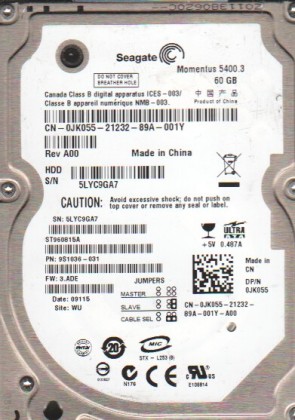
The Seagate ST960815A is a 60GB 2.5-inch Parallel ATA (PATA) hard disk drive targeting legacy laptop and portable storage upgrades. It operates at 5400 RPM and features an 8MB cache buffer, positioning it as a mid-range solution for systems requiring compatibility with older parallel ATA interfaces rather than modern SATA connections. Its primary users are those maintaining or restoring vintage notebooks, industrial embedded systems, or external enclosures from the mid-2000s era.
Core specifications include a formatted capacity of 60GB, an Ultra ATA/100 interface (also known as PATA or IDE), and a spin speed of 5400 RPM. The drive uses perpendicular recording technology to achieve a higher areal density on its single platter. Physical dimensions are standard for a 9.5mm-height 2.5-inch drive, weighing approximately 99 grams. Sustained transfer rates reach up to 80 MB/s in ideal sequential reads, while average seek time is rated at 12 milliseconds.
In real-world performance, the ST960815A delivers reliable sequential read speeds around 60-65 MB/s and write speeds of 55-60 MB/s, which is adequate for booting lightweight operating systems like Windows XP or older Linux distributions. Random access times for 4KB reads hover near 15-18 milliseconds due to the 5400 RPM spindle. The drive runs relatively cool during light usage, typically staying below 40°C in a well-ventilated laptop chassis, but can reach 45°C under sustained heavy file transfers.
Key advantages include broad compatibility with legacy PATA ports, low power consumption (around 1.5W during active use and 0.5W idle), and silent operation with no audible vibration. Its cost-effectiveness for retro upgrade projects is notable, as new-old-stock units can often be found for under $30. However, the main drawbacks are its limited capacity compared to even cheap SSDs, significantly slower random I/O than any flash storage, and the fragility of mechanical platters against physical shock. The PATA interface also caps burst transfer rates at 100 MB/s, bottlenecking any potential speed from modern caching.
This drive is best suited for niche applications: breathing life into older laptops that lack SATA support, replacing failed drives in industrial CNC controllers or POS terminals, or building a period-correct external HDD enclosure. It is not recommended for use as a primary OS drive in any modern system due to sluggish boot times and severe performance limitations in multitasking environments. File servers relying on sequential archival storage might also benefit if the host board has only PATA connectors.
For purchase decisions, users should verify the drive’s condition if buying used, checking for reallocated sectors via S.M.A.R.T. data. New-old-stock units are preferable but may lack manufacturer warranty. Budget $20-30 for a bare drive; avoid paying more than $50 as better performance/capacity PATA alternatives (like 120GB models) exist. Given the drive’s age, pairing it with a lightweight OS and storing only static data is advised. For mission-critical backups, choose a modern SSD in a SATA-to-PATA adapter instead.