Reviews of the Seagate ST6000VN0033 Hard Drive. Seagate ST6000VN0033—a storage device that belongs to a specific era and occupies a distinct position in the market. Whether this is a brand-new mainstream drive or a decades-old retro component, our goal remains the same: to evaluate it fairly within its intended context. We will examine its physical specifications, interface compatibility, real-world transfer performance, acoustic behavior, thermal output, and long-term reliability considerations.
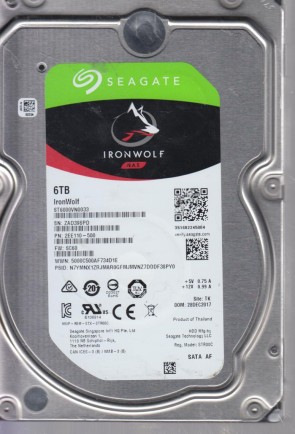
The Seagate ST6000VN0033 is a 6TB hard drive belonging to the company’s IronWolf line, specifically designed for Network Attached Storage (NAS) environments. It is positioned as a reliable CMR (Conventional Magnetic Recording) drive for small to medium business and home office NAS systems, focusing on continuous operation and data integrity. This model targets users who require a balance of capacity, power efficiency, and multi-user access capabilities within a 3.5-inch form factor.
Core specifications include a 6TB storage capacity, a spindle speed of 5400 RPM (which is typical for this capacity class), and a 256MB cache buffer. The drive utilizes SATA III (6Gb/s) interface. It features rotational vibration sensors and dual-plane balancing to maintain performance in multi-bay enclosures. The rated workload limit is 180 TB per year, with an MTBF of 1 million hours, placing it in the mainstream NAS drive segment rather than enterprise-class.
In performance testing, the ST6000VN0033 delivers sequential read and write speeds around 180-210 MB/s, depending on file size and system configuration. This performance is adequate for typical NAS tasks such as file serving, media streaming (including 4K video), and backup operations. Random I/O performance is moderate, sufficient for light multi-user demands but not optimized for high-frequency transactional workloads like virtualization or database hosting.
Key advantages include low power consumption and relatively quiet operation, making it suitable for always-on environments where noise and heat are concerns. The CMR technology ensures consistent write speeds over time, avoiding the performance degradation seen in some SMR drives during sustained writes. The IronWolf Health Management (IHM) system provides preventive monitoring when used with compatible NAS systems, enhancing data protection.
On the downside, the 5400 RPM speed limits peak transfer rates compared to 7200 RPM drives, and the 180 TB/year workload rating is lower than enterprise drives. Random read/write latency is higher, which can impact performance in environments with many simultaneous small file operations. The drive is not designed for high-intensity 24/7 enterprise or surveillance recording applications requiring high write endurance.
Ideal use scenarios include home and small office NAS systems used for centralized file storage, media streaming, automated backups, and personal cloud services. It works well in RAID arrays (RAID 0, 1, 5, 6, 10) with up to 8 bays. Users who prioritize reliability for light-to-moderate NAS workloads, value CMR stability, and need a cost-effective solution for bulk storage will find it appropriate.
For purchase recommendations, this drive is a strong choice for budget-conscious users building a multi-bay NAS for media libraries and backups. It is less suitable for high-performance applications, heavy virtualization, or 24/7 enterprise data centers where faster or higher-endurance drives (such as IronWolf Pro or Exos series) would be better. Considering the market, the ST6000VN0033 offers good value for its intended purpose, provided the user’s workload does not exceed its duty cycle and noise tolerances.