Reviews of the Seagate ST373207LW Hard Drive. Seagate ST373207LW—a storage device that belongs to a specific era and occupies a distinct position in the market. Whether this is a brand-new mainstream drive or a decades-old retro component, our goal remains the same: to evaluate it fairly within its intended context. We will examine its physical specifications, interface compatibility, real-world transfer performance, acoustic behavior, thermal output, and long-term reliability considerations.
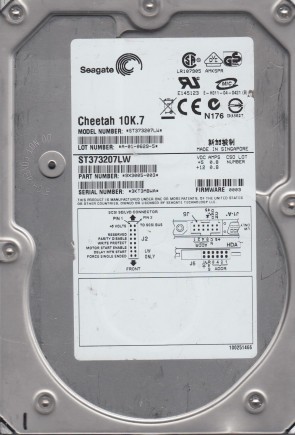
The Seagate ST373207LW is an enterprise-class Ultra320 SCSI hard drive from the early 2000s, designed for high-reliability storage in server and workstation environments. It belongs to Seagate’s Cheetah 10K.7 family, leveraging a 3.5-inch form factor and a rotational speed of 10,000 RPM for consistent data access.
Core specifications include a formatted capacity of 73.4 GB, an 8 MB cache buffer, and an Ultra320 SCSI interface with a maximum transfer rate of 320 MB/s. The drive integrates an 80-pin SCA connector for hot-swap backplanes and features a mean time between failures (MTBF) rated at 1.2 million hours, reflecting its intended 24/7 duty cycle.
In performance benchmarks, the ST373207LW delivers sequential read speeds around 68 MB/s and write speeds near 55 MB/s, with an average seek time of approximately 4.7 milliseconds. Random I/O operations are robust for its era, handling around 200 IOPS on typical server workloads, but it trails modern SSDs and even later HDDs by a wide margin.
Advantages of this drive include exceptional build quality with a dual-stage actuator and rotational vibration tolerance, making it suitable for RAID arrays. The SCSI command set enables advanced features like tagged command queuing, improving multi-tasking efficiency. However, its capacity is minuscule by today’s standards, and the drive is loud, power-hungry (around 10-12 watts active), and generates considerable heat.
Primary disadvantages are its outdated interface and low storage density. The Ultra320 SCSI controller requires a matching host adapter, which is no longer common in modern motherboards. Performance is inadequate for any modern operating system or application, and replacement drives or parts are difficult to source, often with high per-gigabyte cost on the secondary market.
Ideal use cases are limited to legacy system restoration, vintage server preservation, or educational demonstrations of SCSI technology. It is not suitable for primary storage, backup, or any current production environment. Enthusiasts maintaining old hardware like Sun Ultra workstations or Compaq ProLiant servers from the early 2000s may find it a necessary replacement part.
Purchase recommendations: Only acquire this drive if you specifically need a drop-in replacement for a legacy SCSI system and have the correct controller and cabling. Avoid buying for general computing or performance purposes. Inspect SMART data if possible, as used units often have high operational hours. Condition and authenticity vary widely on resale platforms.