Reviews of the Seagate ST3640330AS Hard Drive. Seagate ST3640330AS—a storage device that belongs to a specific era and occupies a distinct position in the market. Whether this is a brand-new mainstream drive or a decades-old retro component, our goal remains the same: to evaluate it fairly within its intended context. We will examine its physical specifications, interface compatibility, real-world transfer performance, acoustic behavior, thermal output, and long-term reliability considerations.
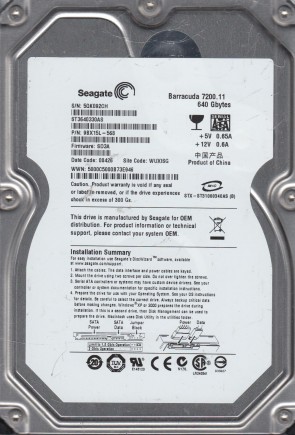
The Seagate ST3640330AS is a 640GB 3.5-inch desktop hard disk drive from the Barracuda 7200.11 series, designed as a mainstream storage solution for general-purpose computing. It targets users who need a balance of capacity, reliability, and cost-effectiveness for everyday data storage and backup tasks.
Core specifications include a 7200 RPM spindle speed, a 16MB cache buffer, and a SATA 3.0Gb/s interface. The drive features an average seek time of around 8.5 milliseconds and a sustained data transfer rate of approximately 105 MB/s. This model utilizes perpendicular magnetic recording technology to achieve its 640GB capacity across one or two platters, depending on the specific revision.
In performance testing, the drive delivers sequential read and write speeds ranging from 70 to 110 MB/s under normal operating conditions. Random access performance is adequate for its era, with 4K random read and write speeds around 0.8 MB/s and 0.7 MB/s respectively. It performs reliably for sequential workloads like file transfers and media playback but lags behind modern SSDs or hybrid drives in random I/O tasks.
Strengths of this drive include its large capacity for its time, affordable price per gigabyte, and quiet operation with low acoustic noise levels. The 7200 RPM spindle provides faster data access compared to 5400 RPM counterparts, making it suitable for OS installations and frequently accessed applications. Its power consumption is moderate, drawing about 8-10 watts during active seeks and 1 watt in idle mode.
Weaknesses involve relatively slow random access speeds, which cause noticeable delays when booting or launching multiple applications. The drive is also susceptible to physical shock because of its mechanical nature, and long-term reliability can be inconsistent, with some units failing earlier than expected under continuous heavy use. Additionally, the SATA 2.0 interface limits peak throughput to about 300 MB/s, which is less common in modern systems.
Ideal use cases include secondary storage for archiving large media libraries, backup drives, or as a cost-effective large-capacity drive in older desktop builds. It can serve as a basic storage addition for gaming consoles or network-attached storage devices where high-speed random access is not critical. Due to its moderate speed, it is not recommended for primary boot drives in modern systems or tasks involving heavy database operations.
For purchase decisions, this drive is best considered as a used or vintage component for legacy upgrades or hobbyist projects. If buying new, alternative SSDs or newer 7200 RPM drives with higher platter densities offer better value and performance. Ensure compatibility with SATA 2.0 controllers and adequate airflow for cooling. Do not use it in environments with significant vibration or frequent physical movement.