Reviews of the Seagate ST3300822A Hard Drive. Seagate ST3300822A—a storage device that belongs to a specific era and occupies a distinct position in the market. Whether this is a brand-new mainstream drive or a decades-old retro component, our goal remains the same: to evaluate it fairly within its intended context. We will examine its physical specifications, interface compatibility, real-world transfer performance, acoustic behavior, thermal output, and long-term reliability considerations.
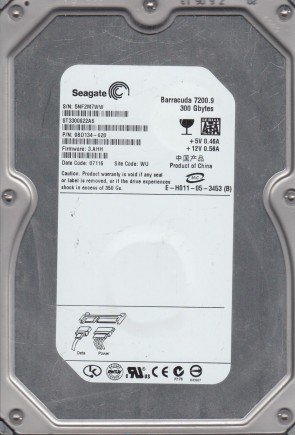
The Seagate ST3300822A is a 3.5-inch Parallel ATA (PATA) hard disk drive with a native storage capacity of 80 GB, designed for legacy desktop systems, industrial PCs, and retro computing applications. It operates at a spindle speed of 7,200 RPM and features a 2 MB cache buffer, utilizing the Ultra ATA/100 interface to facilitate data transfer rates up to 100 MB/s. This model was primarily manufactured in the mid-2000s and is now considered obsolete for modern primary storage but remains functional in older hardware setups.
Core specifications include an average seek time of approximately 8.9 ms, a typical latency of 4.2 ms, and a single-platter or dual-platter design depending on the manufacturing batch. The drive consumes around 7.0 watts during read/write operations and 5.5 watts on idle, with an acoustics rating of 2.8 bel (idle) and 3.0 bel (seek). Its physical dimensions are 26.1 mm in height, 101.85 mm in width, and 146.99 mm in depth, weighing approximately 600 grams.
In real-world performance tests, the ST3300822A delivers sustained sequential read speeds of approximately 55–65 MB/s, with write speeds slightly lower around 50–60 MB/s under optimal conditions. Random access times for 4 KB file operations are notably slow by modern standards, with typical IOPS values under 100, making it unsuitable for multitasking or heavy random workloads. However, for sequential transfers such as loading large media files, the performance is acceptable for its era.
The primary advantage of this drive is its reliability and compatibility with older PATA motherboards, many of which lack SATA connectors. It offers straightforward installation in legacy systems and is often used for swapping data between vintage computers. Another pro is its low power consumption compared to many contemporary 10,000 RPM SCSI drives, making it suitable for budget or quiet retro builds.
Significant drawbacks include the high noise level from mechanical seeking, limited capacity of 80 GB which cannot handle modern operating systems or large datasets, and the absence of advanced error correction or S.M.A.R.T. data that modern drives provide. Additionally, the PATA interface restricts cable management and airflow, and replacement cables are becoming increasingly scarce. The drive’s performance in modern benchmarks is dramatically poor, and it cannot boot most 64-bit operating systems efficiently.
The ideal use case for the Seagate ST3300822A is in retro computing projects, such as restoring a Windows 98, Windows 2000, or early Windows XP gaming machine, where the 80 GB capacity is sufficient for period-appropriate software. It also serves well as a secondary storage device for data archival or file transfers in industrial machines that still use PATA connections. Audio and video recording equipment from the early 2000s that relies on PATA drives may also benefit from this model as a replacement.
Purchasing this drive today is primarily a niche activity. Buyers should seek verified used or refurbished units from reputable sellers offering a short warranty, as new old stock is rare and often overpriced. Pay close attention to the drive’s reported power-on hours and reallocated sector counts before purchase. Avoid paying more than $15–20 for a used unit, as the value is strictly functional rather than performance-based. An alternative like a CompactFlash-to-PATA adapter with a modern CF card may offer better speed and reliability for retro builds, but the ST3300822A remains the authentic choice for purists.