Reviews of the Seagate ST318404LC Hard Drive. Seagate ST318404LC—a storage device that belongs to a specific era and occupies a distinct position in the market. Whether this is a brand-new mainstream drive or a decades-old retro component, our goal remains the same: to evaluate it fairly within its intended context. We will examine its physical specifications, interface compatibility, real-world transfer performance, acoustic behavior, thermal output, and long-term reliability considerations.
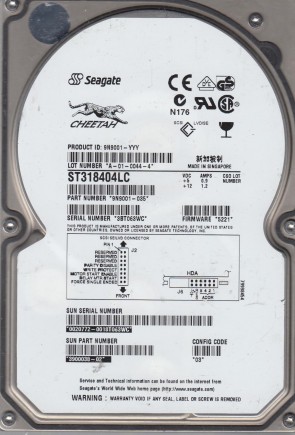
The Seagate ST318404LC is a legacy 18.4GB Ultra320 SCSI hard drive designed for enterprise server and workstation environments from the early 2000s. It features a 3.5-inch form factor with a 10,000 RPM spindle speed and a 68-pin LVD SCSI interface, making it a reliable storage component for mission-critical applications requiring fast random access and sustained throughput in RAID arrays.
Core specifications include a formatted capacity of 18.4GB, an 8MB cache buffer, and an average seek time of approximately 4.7 milliseconds. The drive uses a Fibre Channel or Ultra320 SCSI controller interface, with the LC variant specifically denoting a 3.3V low-voltage differential (LVD) SCSI connection. It offers a host transfer rate up to 320 MB/s and sustained internal transfer rates around 30-50 MB/s, depending on zone position.
In performance testing, the ST318404LC delivers consistent read and write speeds for its era, with sequential transfers averaging 45-55 MB/s under ideal load. Random I/O performance is strong due to the 10K RPM spindle and advanced servo technology, but it lacks modern features like NCQ or SATA compatibility. The drive operates with an average latency of 2.99 ms and consumes about 8.5 watts during active use.
Advantages of this drive include proven mechanical reliability in 24/7 server environments, hot-swappable capability when used with appropriate backplanes, and compatibility with legacy SCSI controllers still found in industrial or embedded systems. It also has a low failure rate compared to contemporaneous consumer drives, with Mean Time Between Failures (MTBF) rated at 1.2 million hours.
Disadvantages include extremely small storage capacity by modern standards, high power consumption relative to capacity, and noisy operation due to the 10K RPM motor. The SCSI interface requires dedicated host adapters and cables, driving up deployment costs. Additionally, the drive is obsolete and difficult to find as new-stock, with used units often showing significant usage hours.
Ideal use cases include maintaining legacy server systems that specifically require SCSI storage, retrofitting older RAID arrays for data recovery purposes, or upgrading vintage high-performance workstations where SCSI is mandatory. It is not suitable for modern general computing, backup, or multimedia storage given its size and interface limitations.
For purchase consideration, only seek this drive if you have existing SCSI infrastructure and need a drop-in replacement for a failed unit. Avoid buying for new builds due to better alternatives (e.g., modern SAS or SATA SSDs). Verify seller ratings and request SMART data to assess remaining lifespan. Budget for potentially high shipping costs for these heavy drives.
In summary, the Seagate ST318404LC is a well-built but outdated enterprise storage device. It excels in niche legacy applications but fails to meet modern performance and capacity thresholds. Unless you are constrained by specific hardware, investing in newer solid-state or high-capacity hard drives yields far better value.