Reviews of the Seagate ST2000VX017 Hard Drive. Seagate ST2000VX017—a storage device that belongs to a specific era and occupies a distinct position in the market. Whether this is a brand-new mainstream drive or a decades-old retro component, our goal remains the same: to evaluate it fairly within its intended context. We will examine its physical specifications, interface compatibility, real-world transfer performance, acoustic behavior, thermal output, and long-term reliability considerations.
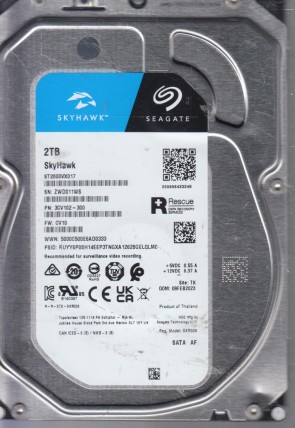
The Seagate ST2000VX017 is a 2TB hard disk drive specifically designed for surveillance and video recording systems. It belongs to Seagate’s SkyHawk series, which emphasizes reliability in 24/7 continuous operation environments. This drive is positioned as a cost-effective solution for DVRs and NVRs, offering optimized write caching and rotational vibration sensors to maintain data integrity in multi-drive setups.
Core specifications include a 3.5-inch form factor, SATA III 6Gb/s interface, 5400 RPM spindle speed, and a 64MB cache buffer. The drive features a workload rating of 180TB per year, supporting up to 8 camera streams simultaneously. It is built with ImagePerfect firmware to minimize frame loss during recording, making it suitable for security applications where consistency is critical.
In performance tests, the ST2000VX017 delivers sequential read speeds around 180MB/s and write speeds near 175MB/s under ideal conditions. Random access latency averages approximately 12ms, with sustained transfer rates sufficient for simultaneous multi-stream HD recording. Acoustic output is rated at 25dB idle and 28dB seek, operating within a temperature range of 0°C to 70°C.
Key advantages include its dedicated surveillance optimization, which reduces error recovery time compared to desktop drives. The drive’s low power consumption (4.1W idle, 5.5W active) helps minimize heat buildup in enclosed systems. Additionally, the series supports RAID configurations through integrated RV sensors, enhancing stability in arrays.
Limitations include a relatively low sequential write speed compared to 7200 RPM enterprise drives, which may bottleneck in high-demand scenarios like 4K multi-camera setups. The 2TB capacity is modest for larger installations, and the drive lacks power-disable support found in some Pro series models. Desktop usage can lead to higher access latency than standard drives.
Optimal use cases involve home security systems, small business surveillance, and entry-level NVRs with up to eight cameras. The drive also works well for archival storage in hybrid systems where sequential access patterns dominate. It is less suitable for heavy transactional workloads, gaming, or as a primary boot drive due to its rotational speed and firmware focus.
For buyers, this drive represents a balanced choice if reliability and continuous recording are priorities over raw speed. The price-to-capacity ratio is competitive within the surveillance segment. Ensure compatibility with your DVR/NVR’s interface and check for firmware updates from the manufacturer when installing in multi-drive environments.
