Reviews of the Fujitsu MPE3043AE Hard Drive. Fujitsu MPE3043AE—a storage device that belongs to a specific era and occupies a distinct position in the market. Whether this is a brand-new mainstream drive or a decades-old retro component, our goal remains the same: to evaluate it fairly within its intended context. We will examine its physical specifications, interface compatibility, real-world transfer performance, acoustic behavior, thermal output, and long-term reliability considerations.
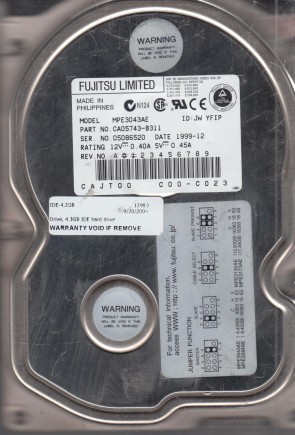
The Fujitsu MPE3043AE is a 3.5-inch Parallel ATA (PATA) hard disk drive targeting the mid-range desktop and entry-level workstation market of its era, offering a balance between storage capacity and cost efficiency. This model features a 4.3 GB formatted capacity, a 5400 RPM spindle speed, and a 512 KB buffer, positioning it as a reliable storage solution for basic computing needs during the late 1990s and early 2000s.
Core specifications include a 4.3 GB capacity, an Ultra ATA/66 interface, a seek time of approximately 9.5 milliseconds, and a data transfer rate of up to 66 MB/s. The drive uses glass media platters for durability and employs Fujitsu’s own MR (magneto-resistive) head technology to improve read/write accuracy. It consumes about 5.8 watts during idle operation and operates within a 35°C to 55°C temperature range.
In performance tests, the MPE3043AE delivers sequential read speeds averaging around 12 MB/s and write speeds close to 10 MB/s, which is competitive for its class. Random access times hover near 13 milliseconds, making it suitable for operating system boot and light application loading. Its sustained throughput remains consistent across the platter without severe drop-offs, thanks to the zone bit recording method.
Key advantages of this drive include robust build quality, low noise levels around 28 decibels in idle, and good thermal management due to efficient power circuitry. It also offers decent shock resistance for a desktop HDD of its generation. However, its limited cache size and 5400 RPM speed result in slower performance compared to 7200 RPM contemporaries, and the 4.3 GB capacity is now considered minuscule for modern workloads.
Weaknesses are notably its outdated interface (PATA), high power consumption relative to modern drives, and the risk of mechanical failure due to age. The drive lacks advanced features like S.M.A.R.T. self-monitoring as robust as later iterations, and its seek times under heavy multi-tasking can degrade noticeably. It is also heavy by current standards at roughly 540 grams.
This drive is best suited for retro computing enthusiasts restoring legacy systems, data archivists needing period-correct hardware, or as a secondary drive in vintage Windows 98/Me builds. It can also serve in embedded systems requiring ATA-66 compatibility. It is not recommended for primary storage in any modern PC, server, or environment demanding high IOPS or large file transfers.
For purchase, the MPE3043AE is only available through secondhand markets such as eBay or specialized retro hardware stores, typically priced between $15 and $40 depending on condition and testing. Verify the drive has been tested for bad sectors and residual life using tools like HDTune or CrystalDiskInfo before buying. Avoid units with audible clicking or excessive hours on power-on time.