Reviews of the Toshiba MK1002MAV Hard Drive. Toshiba MK1002MAV—a storage device that belongs to a specific era and occupies a distinct position in the market. Whether this is a brand-new mainstream drive or a decades-old retro component, our goal remains the same: to evaluate it fairly within its intended context. We will examine its physical specifications, interface compatibility, real-world transfer performance, acoustic behavior, thermal output, and long-term reliability considerations.
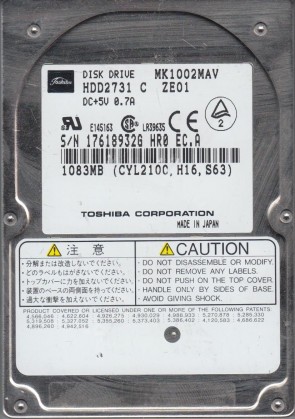
The Toshiba MK1002MAV is a 2.5-inch, 100GB PATA (Parallel ATA) hard disk drive designed primarily for legacy laptops, embedded systems, and industrial applications requiring reliable data storage in a compact form factor. Its product positioning is that of a cost-effective, high-capacity storage solution for older devices lacking SATA support, emphasizing dependability over cutting-edge speed. This drive utilizes traditional spinning magnetic platters with a spindle speed of 5400 RPM and a 2MB buffer, placing it firmly in the value-oriented segment of the hard drive market.
Core specifications include a formatted capacity of 100GB, an interface transfer rate of 100 MB/s (Ultra DMA Mode 5), and an average seek time of approximately 12 milliseconds. The drive has a physical height of 9.5mm, a weight of around 98 grams, and operates on a 5V power supply. It features a built-in shock sensor for enhanced durability during portable use, and its power consumption is rated at 2.0W during read/write operations and 0.5W in idle mode, making it relatively energy-efficient for its generation.
In terms of real-world performance, the MK1002MAV delivers sequential read and write speeds of roughly 35-45 MB/s under normal conditions. This is typical for 5400 RPM PATA drives and allows for smooth operation of the operating system and basic applications on older computers. Random access times are adequate for single-user environments, but the limited 2MB cache and aging interface mean it struggles with multitasking or large file transfers. It is decidedly slower than modern SATA SSDs or even contemporary 7200 RPM hard drives.
The main advantages of this drive include its high compatibility with vintage PATA systems, low power draw, and robust mechanical construction that often results in long operational lifespans in low-usage scenarios. It is also very affordable when found on secondary markets. However, its drawbacks are significant: extremely slow data transfer rates by modern standards, a small cache buffer, the use of outdated PATA connectivity, and potential availability issues as it is no longer in production.
Common applications for the Toshiba MK1002MAV include upgrading or replacing failed drives in early 2000s laptops, restoring classic gaming consoles like the original Xbox, or serving as boot drives in embedded industrial PCs that still rely on PATA connections. It is not suitable for modern gaming, video editing, or any workload requiring fast access times. Its performance is best matched to basic office tasks, archiving, and running legacy software.
For purchase consideration, this drive is best sourced from used or refurbished suppliers, as new old stock is extremely rare. Buyers should verify the condition and check for bad sectors before installation. A more practical alternative for most users is a PATA-to-SSD adapter paired with a modern SATA SSD, which provides dramatically better speed and reliability. However, for purists requiring an exact original replacement for a classic system, the MK1002MAV remains a functional and cost-effective choice.
In summary, the Toshiba MK1002MAV is a reliable but obsolete storage device that serves a very niche audience of retro computing enthusiasts and industrial users. It excels in compatibility and durability for its intended platforms but fails in performance compared to any modern storage option. Buyers should clearly assess their need for native PATA support before choosing this drive, as its limitations are significant in any performance-oriented context.