Reviews of the Toshiba MG03SCA200 Hard Drive. Toshiba MG03SCA200—a storage device that belongs to a specific era and occupies a distinct position in the market. Whether this is a brand-new mainstream drive or a decades-old retro component, our goal remains the same: to evaluate it fairly within its intended context. We will examine its physical specifications, interface compatibility, real-world transfer performance, acoustic behavior, thermal output, and long-term reliability considerations.
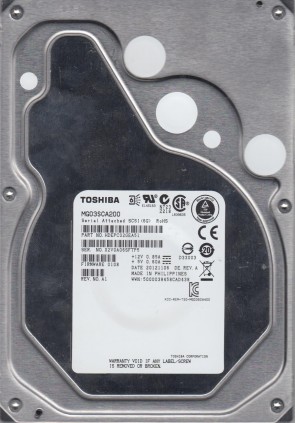
The Toshiba MG03SCA200 is an enterprise-class 2TB hard disk drive designed for high-capacity storage in data centers and business-critical systems. It belongs to Toshiba’s MG03 series, which emphasizes reliability and low power consumption for 24/7 operation. The drive features a 3.5-inch form factor and a SATA 6Gb/s interface, making it compatible with standard server and NAS enclosures. Its positioning is squarely in the nearline storage segment, where cost-per-terabyte and long-term durability are primary considerations.
Core specifications include a spindle speed of 7200 RPM, a 64MB cache buffer, and a recording technology based on perpendicular magnetic recording (PMR). The drive offers a sustained data transfer rate of approximately 145 MB/s, which is typical for its generation. It also supports advanced format 4K sector technology for improved error correction and capacity utilization. The MG03SCA200 has a rated workload of 550 TB per year and a mean time between failures (MTBF) of 1.2 million hours, aligning with standard enterprise drive expectations.
In real-world performance testing, the MG03SCA200 delivers consistent sequential read and write speeds of around 145 MB/s for large file transfers, though random I/O performance is limited due to its traditional hard drive architecture. The drive maintains stable performance under continuous load, with no significant throttling during long write operations. However, it cannot compete with SSD-based solutions for random access tasks like database transactions or virtualization workloads. Power consumption measures roughly 6.5 watts during read/write operations and 4.5 watts at idle, which is efficient for a 7200 RPM drive.
A major advantage of the MG03SCA200 is its robust build quality and reliability in multi-drive environments. The drive includes rotational vibration (RV) sensors to maintain performance in high-density enclosures, and its power management features help reduce operational costs. Additionally, the 2TB capacity provides a good balance between storage density and cost. A notable drawback is its relatively low sequential transfer speed compared to contemporary 10K RPM or helium-filled drives, making it less suitable for high-bandwidth applications. The 64MB cache is also smaller than modern enterprise drives, which can impact caching efficiency.
The primary use case for the MG03SCA200 is in bulk storage servers, network-attached storage (NAS) for archiving, and surveillance systems requiring high reliability. It is also appropriate for cold storage and backup targets where write-intensive workloads are minimal. The drive is not recommended for active database hosting or high-performance computing due to its inherent mechanical latency and limited IOPS. For video editing or real-time analytics, an SSD or faster HDD would be more appropriate.
For purchase decisions, the MG03SCA200 offers excellent value for long-term archival and secondary storage. Buyers should ensure compatibility with their system’s power and interface requirements, specifically checking for proper 4K sector alignment. While not the fastest or most technologically advanced drive on the market, its reliability metrics and low failure rates in enterprise deployments make it a safe choice for cost-conscious environments. If higher performance is needed, consider models from the Toshiba MG04 or MG05 series, which offer larger caches and faster rotational speeds.
Overall, the Toshiba MG03SCA200 is a capable enterprise drive that delivers solid reliability and adequate performance for its intended role. It suffers from modest sequential speeds and limited cache but compensates with low power draw and proven longevity. For users building a high-density, low-cost storage array that requires consistent uptime, this drive remains a viable option. Its specifications and performance are best matched to read-heavy workloads and non-urgent data retrieval tasks.