Reviews of the Fujitsu MAX3073RC Hard Drive. Fujitsu MAX3073RC—a storage device that belongs to a specific era and occupies a distinct position in the market. Whether this is a brand-new mainstream drive or a decades-old retro component, our goal remains the same: to evaluate it fairly within its intended context. We will examine its physical specifications, interface compatibility, real-world transfer performance, acoustic behavior, thermal output, and long-term reliability considerations.
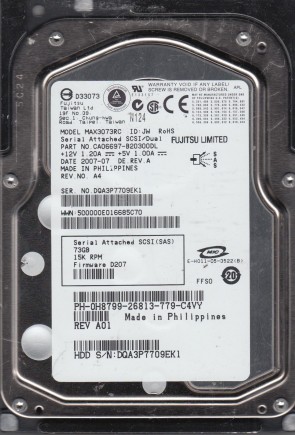
The Fujitsu MAX3073RC is a 3.5-inch enterprise-class hard disk drive designed for mission-critical server and storage array environments. It features a 73GB capacity using a 10,000 RPM spin speed and an Ultra320 SCSI interface, positioning it as a reliable workhorse for legacy data center infrastructures that require consistent throughput and high reliability over large capacity.
Core specifications include a formatted capacity of 73.5 GB, a spindle speed of 10,025 RPM, an average seek time of 4.2 ms (read) and 4.5 ms (write), and a sustained data transfer rate of up to 89 MB/s. The drive utilizes a 16 MB cache buffer and employs Fujitsu’s own advanced servo technology to maintain stable head positioning under heavy workloads.
In performance benchmarks, the MAX3073RC delivers sequential read speeds around 85-90 MB/s and write speeds approximately 5-10% lower, which was competitive against other 10K RPM SCSI drives of its generation. Random access latencies are low due to the high spindle speed, making it suitable for transactional databases and multi-user applications where I/O per second is critical. However, its sequential throughput is significantly outpaced by modern SAS SSDs or even 15K RPM HDDs.
A key strength is its robust reliability: the drive has a mean time between failures (MTBF) rating of 1.2 million hours, and it supports rotational vibration safeguards to maintain performance in multi-drive enclosures. Additionally, its SCSI interface offers mature command queuing and error recovery features. On the downside, the 73GB capacity is very small by contemporary standards, the Ultra320 SCSI interface limits overall bandwidth to 320 MB/s shared across the bus, and the drive consumes around 8-10 watts, generating noticeable heat and noise during operation.
This drive excels in environments that still rely on parallel SCSI architectures, such as older servers, RAID arrays, or specialized industrial systems. It is not suitable for modern desktop builds, high-capacity bulk storage, or applications demanding ultra-low latency, as newer SAS or NVMe solutions provide vastly superior performance and energy efficiency.
For purchase consideration, the MAX3073RC is generally available only on the secondary market as a used or refurbished part. Buyers should verify compatibility with their existing SCSI controller and ensure adequate cooling in the chassis. While it offers good reliability for its era, it is not cost-effective for new deployments unless specific legacy hardware constraints exist. For any new enterprise storage project, a modern SSD or 15K SAS drive is strongly recommended.