Reviews of the Hitachi IC35L080AVVA07-0 Hard Drive. Hitachi IC35L080AVVA07-0—a storage device that belongs to a specific era and occupies a distinct position in the market. Whether this is a brand-new mainstream drive or a decades-old retro component, our goal remains the same: to evaluate it fairly within its intended context. We will examine its physical specifications, interface compatibility, real-world transfer performance, acoustic behavior, thermal output, and long-term reliability considerations.
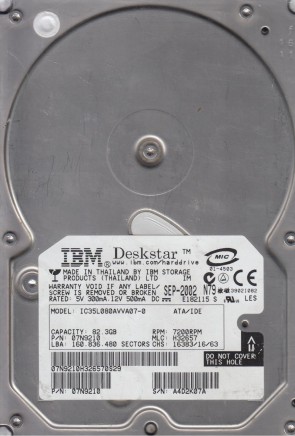
The Hitachi IC35L080AVVA07-0 is a legacy 3.5-inch internal hard disk drive (HDD) positioned for desktop storage applications from the early 2000s. As part of Hitachi’s Deskstar series, it was designed for mainstream PC users requiring reliable bulk storage at a time when capacities around 80 GB were standard. This model utilizes an Ultra ATA/100 interface, connecting via a 40-pin IDE cable, and is not compatible with modern SATA-only systems without an adapter.
Core specifications include a formatted capacity of 80 GB, a spindle speed of 7,200 RPM, and a 2 MB buffer cache. The drive features an average seek time of approximately 8.5 ms and a data transfer rate of up to 100 MB/s over the ATA bus. It employs a single 80 GB platter with an areal density that was competitive for its era, contributing to a relatively lightweight design for a desktop HDD.
In performance benchmarks, the IC35L080AVVA07-0 delivers sequential read and write speeds around 40–50 MB/s, typical for 7200 RPM drives of its generation. Random access times are modest, and the small 2 MB cache limits multitasking efficiency compared to later drives. Sustained throughput drops on outer to inner tracks, but overall it performs adequately for booting legacy operating systems like Windows XP or storing media files.
Key advantages of this drive include its proven reliability in office and home environments, low power consumption for its time, and compatibility with older motherboards that lack SATA ports. It also operates quietly under normal load and generates moderate heat. However, disadvantages are significant by modern standards: very low capacity and speed, a fragile IDE connector, and no support for advanced features like native command queuing or S.M.A.R.T. beyond basic monitoring.
The primary use case for this Hitachi drive is as a replacement or upgrade for vintage computer systems, such as retro gaming PCs, industrial embedded devices, or data recovery projects requiring identical firmware. It is not suitable as a primary drive for modern operating systems or applications requiring high data throughput. Enthusiasts maintaining legacy hardware will find it a compatible, straightforward storage solution.
For purchase considerations, the IC35L080AVVA07-0 is now only available on the secondary market, typically at low prices ranging from $5 to $15. Buyers should verify the drive’s condition through S.M.A.R.T. data, as long storage periods or heavy use may have reduced lifespan. Avoid purchasing units with excessive reallocated sectors or high power-on hours. Given its age, budgeting for a backup solution is also advised, as any vintage HDD carries inherent failure risk.
In summary, the Hitachi IC35L080AVVA07-0 is a competent period-specific hard drive for retro computing demands but offers no practical use in current-generation builds. Its value lies entirely in preserving or repairing older equipment. Enthusiasts seeking maximum compatibility should confirm motherboard IDE support and consider an affordable price point; for all other users, a modern SSD or SATA HDD is strongly recommended.