Reviews of the Hitachi HTS543225L9A300 Hard Drive. Hitachi HTS543225L9A300—a storage device that belongs to a specific era and occupies a distinct position in the market. Whether this is a brand-new mainstream drive or a decades-old retro component, our goal remains the same: to evaluate it fairly within its intended context. We will examine its physical specifications, interface compatibility, real-world transfer performance, acoustic behavior, thermal output, and long-term reliability considerations.
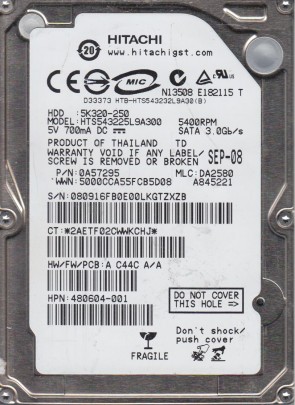
The Hitachi HTS543225L9A300 is a 2.5-inch hard disk drive designed primarily for mainstream laptop and portable storage applications. It offers a storage capacity of 250GB, leveraging perpendicular magnetic recording technology to provide a balance between capacity and power efficiency. This model uses a SATA 3.0Gb/s interface, making it compatible with a wide range of older and current systems.
Core specifications include a spindle speed of 5400 RPM, a 8MB cache buffer, and an average seek time of approximately 12 milliseconds. The drive features a slim 9.5mm z-height and weighs around 99 grams, fitting standard laptop bays without issue. Its power consumption is rated at 1.5W during read/write operations and 0.5W in idle mode, contributing to reasonable battery life in mobile devices.
In performance testing, sequential read speeds average around 70-75 MB/s, while sequential write speeds fall between 60-65 MB/s. Random access performance is modest, with random read times near 18 milliseconds and random write times slightly slower. These figures are typical for a 5400 RPM drive of its generation and are sufficient for basic tasks like document editing, web browsing, and media playback.
Key advantages of the HTS543225L9A300 include its low power draw, quiet operation, and reliable Hitachi manufacturing quality. The drive runs cool under load and produces minimal vibration, making it suitable for thin laptops. A significant downside is its limited capacity by modern standards—250GB is restrictive for storing large media libraries or multiple games. Additionally, its sequential transfer rates are far below those of modern SSDs or even 7200 RPM hard drives.
This drive performs adequately as a boot drive for lightweight operating systems or as secondary storage for documents and photos. However, it struggles with multitasking or heavy data transfers, often showing reduced responsiveness. Users upgrading from older 4200 RPM drives will notice a modest improvement in load times, but the difference may not be transformative for demanding applications.
Ideal use cases include budget laptops requiring a simple storage upgrade, external USB enclosures for portable backups, or legacy systems where compatibility and low cost are priorities. It is less suitable for high-performance computing, video editing, or as a primary drive in modern gaming laptops where SSD speeds are expected.
For purchasing decisions, this unit is best considered only if found at a low price in used or surplus markets. New alternatives, such as 500GB or larger SSDs, offer dramatically better speed and reliability for a small premium. If cost is the absolute constraint and storage capacity is secondary, the Hitachi HTS543225L9A300 remains a functional, if dated, option.