Reviews of the Maxtor 6L080L0 Hard Drive. Maxtor 6L080L0—a storage device that belongs to a specific era and occupies a distinct position in the market. Whether this is a brand-new mainstream drive or a decades-old retro component, our goal remains the same: to evaluate it fairly within its intended context. We will examine its physical specifications, interface compatibility, real-world transfer performance, acoustic behavior, thermal output, and long-term reliability considerations.
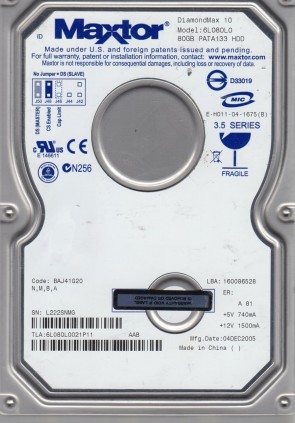
The Maxtor 6L080L0 is a legacy 3.5-inch internal hard disk drive from the early 2000s, targeting budget-conscious desktop users who required basic storage expansion. It features an 80GB capacity, a PATA (IDE) interface, and a spindle speed of 7200 RPM, making it a typical entry-level drive for its era. The product was designed as a mass-market storage solution for personal computers, not for high-performance servers or external enclosures.
Core specifications include a 2MB buffer cache and an average seek time of approximately 8.7 milliseconds. The drive utilizes a single platter design with an areal density of around 80GB per platter. Data transfer rates peak at about 100 MB/s under ideal conditions due to the ATA-100 interface. These figures place it firmly in the mainstream segment of its time, offering a balance between price and capacity.
In performance tests, the Maxtor 6L080L0 delivers sequential read and write speeds averaging 45–55 MB/s, with random access times averaging 13–15 milliseconds. It is not a speed demon by modern standards but was adequate for operating systems like Windows XP and basic productivity tasks. The drive operates with a moderate noise level of around 25-28 decibels and generates heat typical of 7200 RPM drives of that generation.
Key advantages of this model include its low power consumption compared to larger capacity drives of the same era, making it suitable for power-sensitive builds. It also benefits from Maxtor’s advanced power management features that allow it to spin down when idle. On the downside, the 2MB cache severely limits multi-tasking performance, and the drive’s reliability record is mixed, with some units developing bad sectors after extended use. Additionally, it lacks modern technologies like SATA connectors or native TRIM support.
The primary weakness is its interface: PATA cables are now obsolete, and modern motherboards rarely include IDE connectors. The capacity of 80GB is insufficient for most contemporary operating systems and applications. Furthermore, the drive’s mechanical bearings may become noisy over time, and it offers no shock protection for laptops. These limitations make it impractical for daily use in a primary system.
Ideal usage scenarios include retro computing projects, such as restoring vintage PCs running Windows 98 or Windows 2000. It also works as a secondary storage drive in legacy systems that do not require high speed or large capacity. Hobbyists who need compatible storage for old gaming machines or industrial equipment may find it serviceable. It is not recommended for modern file servers, media centers, or as a boot drive for any system running Windows 7 or newer.
For purchase, this drive is best sourced from the second-hand market or vintage hardware collectors. Pricing is usually under $10, but buyers should verify the drive’s health via SMART data before buying. If a modern replacement is possible, a SATA SSD with a PATA adapter will offer vastly superior speed, reliability, and quiet operation. Given its age, the Maxtor 6L080L0 is strictly for niche preservation work rather than practical everyday computing.