Reviews of the Fujitsu MHV2080BS Hard Drive. Fujitsu MHV2080BS—a storage device that belongs to a specific era and occupies a distinct position in the market. Whether this is a brand-new mainstream drive or a decades-old retro component, our goal remains the same: to evaluate it fairly within its intended context. We will examine its physical specifications, interface compatibility, real-world transfer performance, acoustic behavior, thermal output, and long-term reliability considerations.
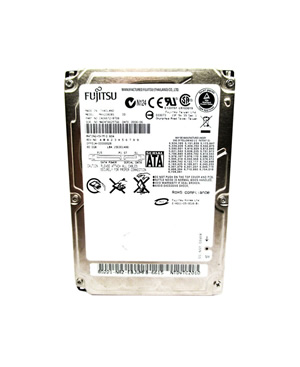
The Fujitsu MHV2080BS is a 2.5-inch internal hard disk drive designed primarily for legacy laptops, portable storage enclosures, and older industrial computing systems where SATA 1.5 Gbps connectivity is required. This model stores 80 GB of data using traditional perpendicular magnetic recording technology, spinning at 5400 RPM with a 2 MB buffer size. It is a parallel ATA (PATA) drive that also supports Serial ATA via its native SATA interface, making it a transitional product from the IDE to SATA era.
Core specifications include a 5400 RPM spindle speed, an average seek time of 12 milliseconds, and a data transfer rate of up to 100 MB/s burst speed. The drive uses a single platter design with a 2 MB cache, and it operates on a 5V power supply with a typical power consumption of around 1.8 watts during read/write operations. Physical dimensions are 70 x 100 x 9.5 millimeters, weighing approximately 99 grams, making it a slim 9.5mm profile suitable for most notebooks of its generation.
In performance benchmarks, the MHV2080BS delivers sequential read and write speeds averaging 35–45 MB/s under typical conditions, with random access times around 18–20 milliseconds. Its sustained throughput is adequate for basic office tasks and file storage, but it lags significantly behind modern solid-state drives or even later 7200 RPM hard drives. The drive produces an acoustic noise level of approximately 24 dB idle and 27 dB seek, which is moderate but noticeable in quiet environments.
Key advantages of this drive include its proven reliability for age-appropriate hardware, low power draw, and compatibility with older SATA 1.5 Gbps controllers that struggle with newer high-speed drives. Its 9.5mm height fits standard laptop bays, and the Fujitsu brand has a reputation for decent durability in its era. However, the 80 GB capacity is extremely limited by modern standards, the 5400 RPM speed causes noticeable sluggishness in multitasking, and the 2 MB cache bottlenecks small file transfers.
Disadvantages are substantial: the drive is obsolete for primary operating system use due to slow load times and high latency compared to any SSD. It lacks advanced features like shock protection or error recovery controls found in enterprise drives. Additionally, finding replacement units today involves purchasing used or NOS (new old stock), which may have unknown usage hours or potential reliability issues related to age.
This drive is best suited for retro computing enthusiasts restoring early 2000s laptops, hobbyists needing storage for legacy industrial machines that require native SATA 1.5 Gbps support, or as a low-cost secondary storage option in a very budget-constrained environment where data size requirements are minimal. It is not appropriate for modern desktop PCs, gaming systems, or any workload demanding speed, large capacity, or silent operation.
For purchase consideration, procuring a used Fujitsu MHV2080BS is only recommended if the system specifically requires this exact model for compatibility reasons, and if the user accepts the risk of age-related failure. Do not pay more than $10–15 for a tested unit, and always verify that the drive passes a full S.M.A.R.T. health check before installation. For most use cases, a low-cost SATA SSD with a similar 2.5-inch form factor will provide vastly superior performance, reliability, and capacity at a similar price point.
