Reviews of the Fujitsu MHZ2320BH G1 Hard Drive. Fujitsu MHZ2320BH G1—a storage device that belongs to a specific era and occupies a distinct position in the market. Whether this is a brand-new mainstream drive or a decades-old retro component, our goal remains the same: to evaluate it fairly within its intended context. We will examine its physical specifications, interface compatibility, real-world transfer performance, acoustic behavior, thermal output, and long-term reliability considerations.
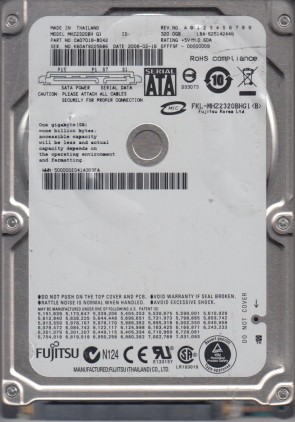
The Fujitsu MHZ2320BH G1 is a 2.5-inch internal hard disk drive designed primarily for use in laptops, portable external enclosures, and other mobile computing devices from the late 2000s. It belongs to Fujitsu’s MHZ series, positioning itself as a reliable storage solution for consumers and business users who require a balance between capacity, cost, and durability during a time when SSDs were not yet mainstream. The drive targets users upgrading older notebooks or seeking secondary storage for legacy systems.
Core specifications include a 320GB storage capacity, a 5400 RPM spindle speed, and a SATA 3.0 Gb/s interface. The drive features an 8MB cache buffer and an average seek time of approximately 12 milliseconds. Its physical dimensions are standard for 9.5mm height 2.5-inch drives, making it compatible with most laptops and enclosures from its era. The operating power consumption is rated around 1.5 watts during read/write operations, with a lower idle consumption of 0.8 watts.
In terms of performance, the MHZ2320BH G1 delivers sequential read speeds up to 70 MB/s and write speeds around 65 MB/s under ideal conditions. These figures are moderate for its generation and sufficient for general computing tasks such as document editing, web browsing, and multimedia playback. Random access latencies are typical for a 5400 RPM drive, resulting in noticeable loading times for applications and boot sequences compared to higher-speed 7200 RPM drives or later SSDs. The drive operates quietly with acoustic levels around 2.3 bel (idle).
Strengths of this model include solid mechanical reliability and a proven track record for data integrity in everyday use. Its low power draw helps extend battery life in laptops, and the cost per gigabyte was competitive at launch. The drive also features Fujitsu’s advanced shock protection technology, offering some resistance to minor physical impacts during transport. Additionally, its widespread compatibility makes it an easy drop-in replacement for many older systems.
Weaknesses are primarily related to performance limitations common to its era. The 5400 RPM speed results in slower data transfer rates compared to 7200 RPM drives or even entry-level SSDs, making it unsuitable for intensive applications like video editing or running modern operating systems efficiently. The 320GB capacity is now considered low for contemporary software libraries. Furthermore, the drive lacks native encryption features and NCQ (Native Command Queuing) is basic, leading to suboptimal performance under heavy multitasking.
This drive is best suited for legacy system repairs, retro computing projects, or as a secondary storage device for data archiving where speed is not critical. It works well in older netbooks or ultraportable laptops where battery life is prioritized over performance. Users running Windows XP or early Windows 7 installations will find the drive adequate for office productivity, email, and light media consumption. It is not recommended for modern gaming, database servers, or as a primary boot drive in current-generation computers.
For purchase consideration, the Fujitsu MHZ2320BH G1 is now a discontinued product and is only available through second-hand markets, surplus suppliers, or as a pull from used equipment. Prices are generally very low, often under $10, reflecting its age and limited capacity. Buyers should verify the drive’s health using S.M.A.R.T. tools before purchasing and anticipate shorter lifespans compared to newer drives. A better investment for most users would be a modern 2.5-inch SSD or larger HDD, unless the specific requirement is to match OEM specifications for an old system.
