Reviews of the Hitachi HUA721010KLA330 Hard Drive. Hitachi HUA721010KLA330—a storage device that belongs to a specific era and occupies a distinct position in the market. Whether this is a brand-new mainstream drive or a decades-old retro component, our goal remains the same: to evaluate it fairly within its intended context. We will examine its physical specifications, interface compatibility, real-world transfer performance, acoustic behavior, thermal output, and long-term reliability considerations.
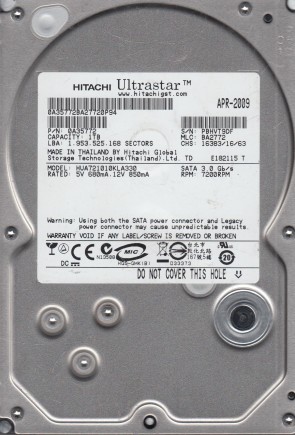
Positioned as an enterprise-class hard disk drive, the Hitachi HUA721010KLA330 targets high-capacity storage environments such as data centers, network-attached storage systems, and archival servers from its release era. It is part of the Ultrastar A7K1000 series, emphasizing reliability and continuous operation rather than high-speed performance for consumer desktops.
The core specifications include a 1TB storage capacity, a 3.5-inch form factor, a SATA 3.0 Gbps interface, and a spindle speed of 7200 RPM. It features a 16MB or 32MB cache buffer, depending on the specific revision, and a claimed average latency of 4.17 milliseconds. The drive utilizes perpendicular magnetic recording technology and operates with a typical power consumption of around 8.5 watts during read/write operations.
In performance benchmarks, the HUA721010KLA330 delivers sequential read and write speeds averaging approximately 80-90 MB/s, which was competitive for its time but is significantly slower than modern 7200 RPM hard drives or solid-state drives. Random access times are measured at about 12.5 milliseconds for reads and 13.5 milliseconds for writes. The drive struggles with sustained heavy workloads due to its lower areal density and older controller architecture.
A primary advantage of this model is its proven enterprise-grade reliability, as it is designed for a 24/7 duty cycle with a mean time between failures rating of 1.2 million hours. It also features Hitachi’s rotary vibration safeguard technology to maintain stability in multi-drive enclosures. However, its drawbacks include relatively low data transfer rates by current standards, higher power consumption and heat output compared to newer drives, and noticeable acoustic noise during active seeking.
The drive is best suited for secondary backup targets, archival storage of large files that are infrequently accessed, or as part of a larger RAID array in legacy systems where raw speed is not critical. It is not recommended as an operating system drive, for hosting active databases, or for any application requiring fast random input/output operations. General consumer use, such as daily file editing or gaming, would also be underwhelming due to its sluggish performance.
For potential buyers, this Hitachi drive represents a cost-effective addition to a homelab or a storage server when purchased used at very low prices. However, for any new build or upgrade, modern alternatives like Western Digital Red Plus or Seagate IronWolf Pro offer far superior performance, better energy efficiency, and higher capacities with similar reliability. Ensure compatibility with legacy SATA II controllers before acquisition, as the drive is fully backward compatible with SATA I and forward compatible with SATA III interfaces.
In summary, the Hitachi HUA721010KLA330 serves as a durable workhorse for specific low-demand storage tasks but is largely obsolete for modern high-speed workloads. Its value lies solely in its rugged enterprise build and low acquisition cost on the secondary market, not in its raw data throughput. Potential buyers should weigh the trade-off between price and performance carefully against contemporary storage solutions.