Reviews of the Hitachi IC35L120AVV207-1 Hard Drive. Hitachi IC35L120AVV207-1—a storage device that belongs to a specific era and occupies a distinct position in the market. Whether this is a brand-new mainstream drive or a decades-old retro component, our goal remains the same: to evaluate it fairly within its intended context. We will examine its physical specifications, interface compatibility, real-world transfer performance, acoustic behavior, thermal output, and long-term reliability considerations.
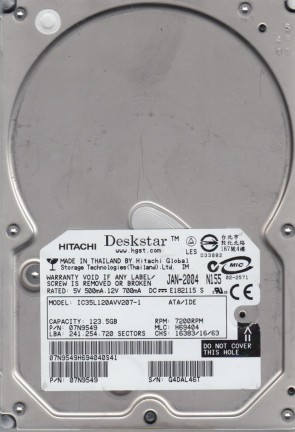
The Hitachi IC35L120AVV207-1 is a 120GB 3.5-inch Parallel ATA (IDE) hard disk drive from the Deskstar 7K250 series, targeted at desktop storage and archival applications in early-to-mid 2000s legacy systems. It operates at a spindle speed of 7200 RPM and features a 2MB buffer with an Ultra ATA/100 interface, positioning it as a mainstream storage solution rather than a high-performance or enterprise-grade unit.
Core specifications include a formatted capacity of 120GB, an average seek time of 8.5 milliseconds, and a data transfer rate of up to 100 MB/s on the interface. The drive uses glass platters and a fluid dynamic bearing motor to reduce noise and vibration. It supports ATA-6 standards and is backwards compatible with older ATA/33 and ATA/66 controllers, making it suitable for upgrading aging computers with IDE interfaces.
In performance benchmarks from the era, the IC35L120AVV207-1 delivers sequential read and write speeds around 40-50 MB/s, which was competitive for its generation. Random access latencies are moderate, and the drive handles typical desktop workloads such as booting, file transfers, and small application loading without stuttering. However, it lags significantly behind modern SATA SSDs in seek times and throughput, and it cannot handle simultaneous high-IO tasks well.
Key advantages of this drive include its relatively low power consumption (around 6.5 watts idle) and quiet operation due to the fluid bearing motor, making it tolerable for home offices or media centers. It also benefits from Hitachi’s Error Recovery Control and thermal monitoring features, which improve reliability in warm environments. The drive is known for consistent performance in non-intensive scenarios, and its 120GB capacity was generous at launch.
However, notable drawbacks exist. The IDE interface is obsolescent, and the drive has a higher failure rate compared to modern storage, with many units from this era exhibiting increased bad sectors or mechanical failures after years of use. The 2MB cache is small by current standards, causing frequent stuttering under multitasking. Additionally, it generates noticeable heat under sustained write loads, and its platter density is low, resulting in slower data density per platter.
This drive is best used in retro computing builds, legacy industrial systems, or as a secondary storage device in older PCs that lack SATA ports. It is not recommended for primary boot drives or any application requiring fast random I/O, such as modern gaming or database servers. For data archiving in vintage hardware, it can be adequate if kept cool and backed up regularly.
For purchase advice, buyers should consider used or NOS (new old stock) units with caution, verifying SMART data and testing thoroughly before relying on the drive. Prices are typically very low, but availability is dwindling. Those needing IDE storage may find better reliability in refurbished Western Digital or Seagate alternatives from the same period. For new builds, investing in an IDE-to-SATA adapter with a modern SSD is a far superior option for speed and longevity.
Overall, the Hitachi IC35L120AVV207-1 is a solid historical component for specific legacy use cases, but it is thoroughly outclassed by all contemporary storage. It earns a reasonable recommendation only for hobbyists and repairers of early 2000s hardware who need authentic components.