Reviews of the Seagate ST1000NC001 Hard Drive. Seagate ST1000NC001—a storage device that belongs to a specific era and occupies a distinct position in the market. Whether this is a brand-new mainstream drive or a decades-old retro component, our goal remains the same: to evaluate it fairly within its intended context. We will examine its physical specifications, interface compatibility, real-world transfer performance, acoustic behavior, thermal output, and long-term reliability considerations.
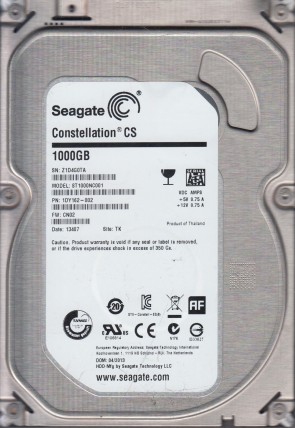
The Seagate ST1000NC001 is a 1TB hard drive designed for network-attached storage (NAS) environments, focusing on reliability and continuous operation rather than raw speed. This 3.5-inch drive operates at 5900 RPM and features a SATA 6Gb/s interface, positioning it as a budget-friendly option for home and small office NAS setups.
Core specifications include a 1TB capacity, 64MB cache buffer, and a spindle speed of 5900 RPM. The drive is built with a conventional magnetic recording (CMR) technology, which offers consistent read/write performance and better data integrity compared to shingled magnetic recording (SMR) drives in multi-user scenarios. Its rated workload limit is 55TB per year, supporting 24/7 operation.
Performance-wise, the ST1000NC001 delivers sequential read speeds around 145MB/s and write speeds of approximately 130MB/s under ideal conditions. Random read/write IOPS are modest, averaging 90-100 for 4K transfers, which is typical for a 5900RPM drive. This makes it adequate for file storage, media streaming, and light backup tasks but not for heavy database or virtualization workloads.
Key advantages include its CMR design, which avoids the performance degradation seen in SMR drives during sustained writes. The drive also has robust vibration tolerance and a lower operating temperature, enhancing reliability in multi-drive NAS chassis. Additionally, it operates quietly at around 20-24 dBA idle noise, suitable for home environments.
Notable disadvantages are its limited throughput compared to 7200RPM or SSD options, and a relatively low cache size prevents it from excelling in burst writes. The 55TB yearly workload rating is lower than enterprise-grade NAS drives (often 180TB/year), so heavy continuous write operations may reduce its lifespan. Furthermore, it lacks advanced error recovery features found in premium NAS drives.
This drive is best suited for basic NAS applications such as centralized file sharing, media servers (e.g., Plex or Emby), and scheduled backup storage. It works well in a single-drive or mirrored RAID configuration for home users needing reliable but economical storage. It is not recommended for high-availability systems or environments requiring frequent large file transfers.
For purchase, the ST1000NC001 offers solid value for light NAS use if budget is a primary concern. However, for users needing higher performance or longer warranties, investing in a 7200RPM NAS drive like the WD Red Plus or Seagate IronWolf is advisable. Verify compatibility with your NAS controller, as some newer units may optimize for SMR drives differently.