Reviews of the Seagate ST310215A Hard Drive. Seagate ST310215A—a storage device that belongs to a specific era and occupies a distinct position in the market. Whether this is a brand-new mainstream drive or a decades-old retro component, our goal remains the same: to evaluate it fairly within its intended context. We will examine its physical specifications, interface compatibility, real-world transfer performance, acoustic behavior, thermal output, and long-term reliability considerations.
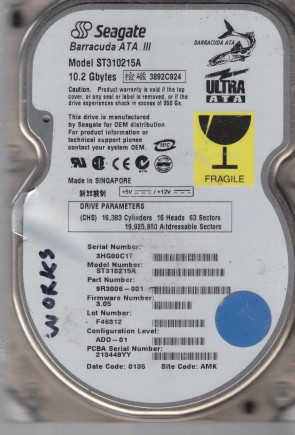
The Seagate ST310215A is a 3.5-inch internal hard disk drive designed for desktop computers, representing an entry-level storage solution from the early 2000s. Its primary product positioning is as a reliable, cost-effective storage device for basic computing tasks such as document storage, operating system installation, and light media playback. With a rotational speed of 5400 RPM and a data transfer interface of Ultra ATA/100, it targets users who need modest storage capacity without demanding high-speed performance.
Core specifications include a formatted capacity of 10 GB, a 2 MB buffer size, and an average seek time of approximately 9.0 ms. The drive uses a single-platter design and operates on a standard 5V/12V power supply, consuming around 7 watts during typical read/write operations. Its physical dimensions conform to the standard 1-inch height form factor for 3.5-inch drives, weighing roughly 500 grams.
In terms of performance, the ST310215A achieves sequential read speeds up to 35 MB/s and write speeds up to 30 MB/s under ideal conditions, which was competitive for its era but severely limited by modern standards. Random access performance is adequate for single-user environments, with low command overhead. However, sustained transfer rates degrade significantly when the drive is nearly full due to the lack of advanced caching algorithms.
Advantages include exceptional mechanical reliability for its generation, with a reported Mean Time Between Failures (MTBF) of 600,000 hours. The drive operates quietly, producing noise levels around 2.5 bels during idle, and remains cool under load due to low power consumption. Additionally, its compatibility with legacy IDE motherboards makes it practical for retro computing or data recovery from old systems.
Disadvantages are substantial by contemporary metrics: the 10 GB capacity is insufficient for modern operating systems or large file collections. The ATA/100 interface bottleneck simplifies performance to below that of any modern SSD or even late-generation HDD. Write speeds are noticeably slower, and the drive lacks native command queuing or error correction features found in later models.
Suitable use cases include primary storage for vintage computers running Windows 98 or earlier operating systems, secondary storage for light data archiving in legacy systems, or as a backup drive in non-critical applications. It is not recommended for server environments, multimedia editing, or any workflow requiring high data throughput.
Purchase considerations focus on availability. The ST310215A is long discontinued, so buyers must seek second-hand or refurbished units. Given its age, verifying the drive’s health through SMART diagnostics is essential. Pricing is typically low, often under $20, but should not exceed $30 due to functional obsolescence. For modern builds, a small SSD or a larger SATA HDD provides far better value.