Reviews of the Seagate ST3320311CS Hard Drive. Seagate ST3320311CS—a storage device that belongs to a specific era and occupies a distinct position in the market. Whether this is a brand-new mainstream drive or a decades-old retro component, our goal remains the same: to evaluate it fairly within its intended context. We will examine its physical specifications, interface compatibility, real-world transfer performance, acoustic behavior, thermal output, and long-term reliability considerations.
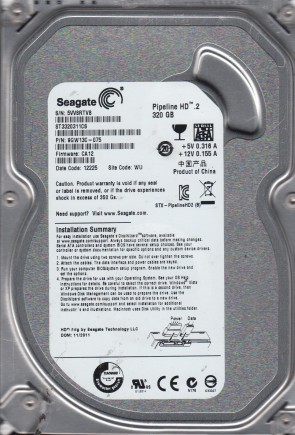
The Seagate ST3320311CS is a 3.5-inch, 320GB hard disk drive designed primarily for consumer electronics and entry-level desktop storage. It relies on traditional perpendicular magnetic recording technology and a 5400 RPM spindle speed, positioning it as a budget-friendly option for basic data storage needs rather than high-speed performance.
Core specifications include a 320GB capacity, a SATA 3.0Gb/s interface, an 8MB cache buffer, and an average seek time of around 12.5 milliseconds. The drive draws up to 5.0 watts during read/write operations and idles at about 3.5 watts, making it relatively power-efficient for its generation.
In performance benchmarks, the ST3320311CS delivers sequential read and write speeds of approximately 85 MB/s and 75 MB/s, respectively. Random access times are modest, typical for a 5400 RPM unit, and it does not support advanced features like Native Command Queueing (NCQ) at high efficiency. Sustained transfer rates drop noticeably as the drive fills, a common trait among low-cost HDDs.
Key advantages include low acoustic noise output—usually rated under 25 decibels during idle—and reliable long-term operation for light workloads. It generates minimal heat, which helps in enclosures with limited airflow. However, its small cache and slow platter speed result in poor performance for multitasking or large file transfers, and the 320GB capacity is now considered very limited for modern media libraries or system drives.
Disadvantages center on its lack of speed and storage volume. It is not suitable for running an operating system, gaming, or any application requiring fast data access. The drive may also struggle with concurrent write requests, leading to occasional slowdowns in multi-user or heavy I/O scenarios. Additionally, older firmware versions have shown compatibility quirks with some SATA controllers.
This drive is best suited for archival storage, external backup enclosures, or secondary data hoarding where speed is not critical. It also fits well in legacy PVRs, DVRs, or media players that prioritize quiet operation over performance. Users with older systems needing a compatible replacement for a failing drive will find it adequate for basic file storage.
For purchase decisions, the ST3320311CS is only recommended if available at a steep discount or as a low-cost filler drive. Most users will find modern 1TB or larger solid-state drives or 7200 RPM hard drives vastly superior for longevity and usability. If the price per gigabyte is competitive and usage is strictly for non-critical archives, it can serve its purpose without issue.
