Reviews of the Seagate ST33220A Hard Drive. Seagate ST33220A—a storage device that belongs to a specific era and occupies a distinct position in the market. Whether this is a brand-new mainstream drive or a decades-old retro component, our goal remains the same: to evaluate it fairly within its intended context. We will examine its physical specifications, interface compatibility, real-world transfer performance, acoustic behavior, thermal output, and long-term reliability considerations.
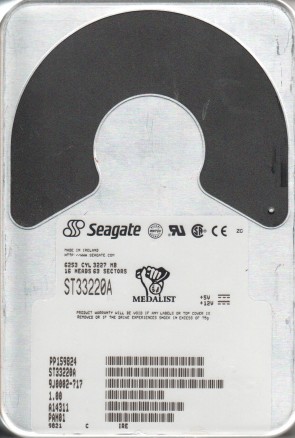
The Seagate ST33220A is a vintage 3.5-inch Parallel ATA (IDE) hard disk drive from the late 1990s, primarily targeted at consumer desktop PCs and entry-level servers of that era. It was positioned as a mainstream storage solution offering a balance between capacity and reliability for early Windows 98, Windows NT, and Linux systems, where operating system and application sizes were significantly smaller than modern standards. Its product category is legacy storage, with no relevance to current high-performance or high-capacity computing.
Core specifications include a formatted capacity of 32.0 GB, a spindle speed of 5400 RPM, and a 2 MB cache buffer. It uses the Ultra ATA/66 interface with a maximum external transfer rate of 66 MB/s. The drive features a single-platter design with a density typical for its time, resulting in an average seek time of approximately 9.0 milliseconds. It is a 3.5-inch form factor unit, weighing less than 600 grams.
In performance benchmarks from its release period, the ST33220A delivers sequential read speeds of up to 30-35 MB/s and write speeds around 25-30 MB/s, constrained by the 5400 RPM spindle and older interface. Random access times are around 13-15 ms due to legacy seek mechanics. Under sustained loads, its performance is acceptable for single-user operating systems and light file transfers but drops significantly with fragmented data or multi-tasking scenarios common in later software.
Primary advantages of this drive are its robust mechanical build, quiet operation for its day, and reliable long-term data retention when stored properly. Its 2 MB cache reduces small-file access delays compared to older 512 KB models. Disadvantages include very low capacity and speed by modern standards, high power consumption (around 7-8 watts idle), and incompatibility with modern SATA-only motherboards without an adapter. It also lacks native S.M.A.R.T. support widely used today.
The ST33220A is best suited for retro computing enthusiasts restoring period-correct Windows 98 or early Linux systems, or for archival purposes where low storage volume is acceptable for legacy software. It can also serve as a secondary storage device in a vintage Pentium II or III build. It is not appropriate for modern operating systems, gaming, video editing, or any application requiring rapid data access or large file handling.
Purchase decisions for this drive should focus on its historical value and functional condition. New old stock units are rare and often expensive; used units carry risk of mechanical wear. Buyers should verify spin-up and SMART status (if compatible) before purchase. For retro builds, it offers authentic performance but for general retro storage, larger 80-160 GB IDE drives from the early 2000s provide better value.
In summary, the Seagate ST33220A is a competent but obsolete storage device with a narrow appeal. Its reliability and quiet operation are highlights within its limited context, but its performance and capacity are far below any practical modern usage. The drive is recommended only for enthusiasts building historically accurate vintage systems or performing low-storage retro computing projects.
