Reviews of the Seagate ST340215AS Hard Drive. Seagate ST340215AS—a storage device that belongs to a specific era and occupies a distinct position in the market. Whether this is a brand-new mainstream drive or a decades-old retro component, our goal remains the same: to evaluate it fairly within its intended context. We will examine its physical specifications, interface compatibility, real-world transfer performance, acoustic behavior, thermal output, and long-term reliability considerations.
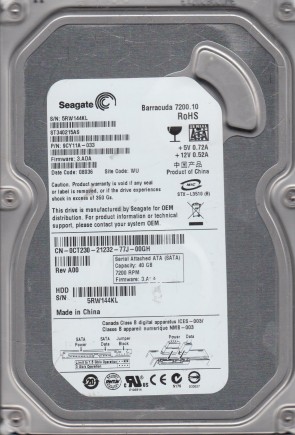
The Seagate ST340215AS is a 40GB 3.5-inch internal hard drive utilizing the Parallel ATA (PATA/IDE) interface, designed primarily for legacy desktop systems and older storage applications. Its product positioning sits firmly within the entry-level storage segment from the mid-2000s, offering a cost-effective solution for basic data storage and operating system installation on computers that lack SATA support.
Core specifications include a spindle speed of 7200 RPM, a 2MB buffer cache, and an average seek time of approximately 8.5 milliseconds. The drive features a PATA/133 interface with a maximum transfer rate of 133 MB/s. The physical dimensions are standard for 3.5-inch drives, and it weighs around 500 grams, making it suitable for direct installation in desktop computer drive bays of that era.
In terms of performance, the ST340215AS provides adequate throughput for common tasks of its time, such as loading Windows XP and launching basic applications. Sequential read and write speeds typically peak around 40-50 MB/s due to the interface and platter density limitations. Random access performance is modest, with the drive handling light multitasking and file operations without significant lag, but it will be severely outpaced by any modern SSD or even a newer 7200 RPM SATA drive.
Key advantages of this drive include its proven reliability and mechanical robustness for its generation, with Seagate being a well-known brand. It also features very low power consumption compared to many modern high-capacity drives, making it a reasonable option for low-thermal environments. The PATA interface allows it to be a direct drop-in upgrade for aging computers that still rely on an IDE bus.
Primary disadvantages are its extremely low capacity of 40GB, which cannot hold a modern operating system or a large game library. The 2MB cache severely limits performance in random access patterns, leading to noticeable delays in file browsing and application loading. Additionally, the PATA interface is obsolete, and connecting it to modern hardware requires a dedicated controller card or a PATA-to-SATA adapter, which adds cost and may introduce compatibility issues.
Suitable use cases include repairing or upgrading vintage desktop computers from the early 2000s, serving as a secondary storage drive in a retro gaming rig, or as a cost-effective option for specific industrial or embedded systems that require a PATA drive. It is also acceptable as a temporary boot drive for older hardware diagnostic or data recovery tasks.
For most users, purchasing this drive today is not recommended unless a legacy IDE connection is absolutely required. A modern solid-state drive with a PATA bridge adapter would provide dramatically faster performance and higher reliability for any similar application. If a pure vintage system must be maintained, buying a used or NOS (new old stock) unit is the only option, and careful condition assessment is advised due to age-related failure risks.
In summary, the Seagate ST340215AS is a competent legacy hard drive for its intended era but is completely obsolete for any modern computing task. Its purchase should be limited to specific historical or compatibility-driven needs, with an understanding that its performance and capacity are severely restrictive by today’s standards.
