Reviews of the Seagate ST34311A Hard Drive. Seagate ST34311A—a storage device that belongs to a specific era and occupies a distinct position in the market. Whether this is a brand-new mainstream drive or a decades-old retro component, our goal remains the same: to evaluate it fairly within its intended context. We will examine its physical specifications, interface compatibility, real-world transfer performance, acoustic behavior, thermal output, and long-term reliability considerations.
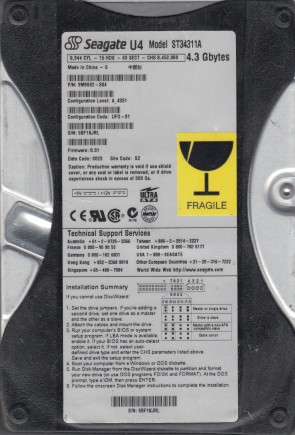
The Seagate ST34311A is an ultra-compact 4.3GB hard disk drive from the late 1990s, designed primarily for legacy desktop PCs and entry-level storage needs. It features a 3.5-inch form factor with an ATA/IDE interface, spinning at 5400 RPM, and was one of Seagate’s budget-focused drives for that era.
Core specifications include a 4.3GB formatted capacity, a 512KB cache buffer, and a sustained data transfer rate of approximately 10-12 MB/s. The drive uses MR (Magneto-Resistive) heads and a single-platter design, making it relatively low-power and quiet for its time.
In practical performance, the ST34311A delivers average sequential read/write speeds around 8-11 MB/s, with random access times typically between 12-15 ms. It was not a speed leader even when new, but it provides adequate responsiveness for basic operating systems like Windows 98 or Windows NT 4.0, as well as simple office applications.
Key advantages of this drive include its low noise levels, modest power consumption (under 10W in active use), and high reliability in low-duty-cycle scenarios. Its small capacity, however, is a major limitation for any modern use, and the ATA/33 interface severely bottlenecks performance by today’s standards.
Disadvantages are significant: the drive is obsolete for mainstream computing, lacks any advanced shock protection, and its small buffer and slow spindle speed make it unsuitable for multitasking or media-intensive tasks. Replacement with modern solid-state storage is far more practical for almost any application.
The ST34311A is best suited for retro computer enthusiasts restoring late-90s PCs, vintage data recovery from legacy systems, or as a historical reference piece. It is not viable for daily use, modern operating systems, or any storage requiring speed or capacity.
Purchase only if you need an exact OEM replacement for an old system or for archival projects with low capacity requirements. Expect to pay a premium for functional units on secondary markets due to rarity, and always verify compatibility with your motherboard’s IDE controller. For any other scenario, modern drives or SSDs are overwhelmingly recommended.