Reviews of the Seagate ST39236LW Hard Drive. Seagate ST39236LW—a storage device that belongs to a specific era and occupies a distinct position in the market. Whether this is a brand-new mainstream drive or a decades-old retro component, our goal remains the same: to evaluate it fairly within its intended context. We will examine its physical specifications, interface compatibility, real-world transfer performance, acoustic behavior, thermal output, and long-term reliability considerations.
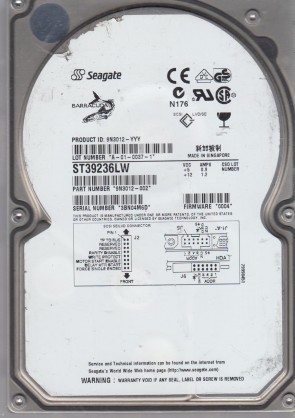
The Seagate ST39236LW is a legacy enterprise-grade hard disk drive from the early 2000s, originally designed for high-reliability storage in server and workstation environments. It features a 9.2 GB formatted capacity, a 3.5-inch form factor, and a SCSI Ultra160 (LVD) interface, targeting data centers requiring fast access to moderate amounts of critical data. Its primary focus is on sustained throughput and error correction under continuous operation, rather than consumer desktop use.
Core specifications include a rotational speed of 10,000 RPM, an average seek time of around 5.4 ms read and 6.0 ms write, and an internal data transfer rate of approximately 69 MB/s. The drive utilizes a 4 MB cache buffer and supports a spindle start/stop cycle rating of 50,000 cycles. It operates with a typical idle power draw of about 10.5 watts and weighs roughly 0.68 kg, with a MTBF (Mean Time Between Failures) rating of 1.2 million hours.
In performance benchmarks typical of its era, the ST39236LW delivers sequential read speeds near 55 MB/s and write speeds around 50 MB/s under sustained loads, which was competitive for a 10K RPM SCSI drive of its generation. Random I/O performance in RAID arrays is respectable due to the low seek latency, making it suitable for multi-user transactional workloads. However, its performance is severely limited by modern standards, with much lower throughput and higher response times compared to contemporary SSDs or even later-gen HDDs.
Strengths include its robust SCSI interface with command queuing, enabling efficient handling of multiple concurrent data requests, and its enterprise-grade reliability with high MTBF and strong error recovery mechanisms. The drive also operates relatively quietly for its speed class and runs cooler than many 15K RPM competitors. A notable advantage is its standardized 80-pin SCA connector, making it easy to hot-swap in compatible server backplanes.
Weaknesses are significant: the capacity (9.2 GB) is minuscule by modern standards, the U160 SCSI bus has low bandwidth (160 MB/s theoretical, shared among devices), and the drive is obsolete, with no firmware updates or manufacturer support. Power consumption and heat output, while modest historically, are inefficient per gigabyte. Additionally, finding working units is increasingly difficult, and interface compatibility with modern systems requires expensive or rare SCSI host adapters.
This drive is suitable only for collectors, retro computing enthusiasts building period-correct servers (e.g., Solaris, NetWare, or early Linux systems), or for those requiring a functional replacement in legacy SCSI storage arrays that have no upgrade path. It is entirely unsuitable for modern storage needs, including operating system installation, media storage, or any performance-critical application due to its low capacity and slow speeds.
Potential buyers should consider purchasing as a spare for an existing system that depends on the precise SCSI topology and connector format. A used drive should be tested with a SCSI utility for reallocation counts and surface errors before deployment. For anyone not constrained by strict hardware compatibility for legacy hardware, a SCSI-to-SSD adapter or a more modern SAS/SATA drive would provide orders-of-magnitude better performance, capacity, and reliability.
In summary, the Seagate ST39236LW is a high-quality SCSI drive that served its purpose well in early-2000s enterprise environments, but it is now a niche product with severe limitations. Its value today lies purely in preservation and compatibility with vintage computing projects, not in practical data storage. A purchase should only be considered by those who specifically need to maintain or restore a SCSI-based system from that era.