Reviews of the Seagate ST9100825A Hard Drive. Seagate ST9100825A—a storage device that belongs to a specific era and occupies a distinct position in the market. Whether this is a brand-new mainstream drive or a decades-old retro component, our goal remains the same: to evaluate it fairly within its intended context. We will examine its physical specifications, interface compatibility, real-world transfer performance, acoustic behavior, thermal output, and long-term reliability considerations.
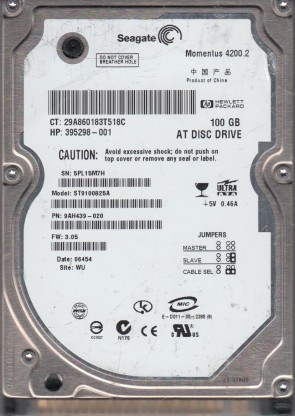
The Seagate ST9100825A is a 2.5-inch, Parallel ATA (PATA) hard disk drive from an era when laptop storage was measured in dozens of gigabytes. Targeted primarily at the mobile computing market of the mid-2000s, this drive was designed to serve as an internal upgrade or factory-fit option for notebooks requiring a reliable boot drive. Its product positioning falls squarely in the value segment, offering a balance of reasonable storage capacity and mechanical durability at a price point that suited budget-conscious consumers and OEMs.
Core specifications include a formatted capacity of 100 gigabytes, a spindle speed of 5400 RPM, and an 8 MB buffer. The interface is Ultra ATA/100, which provides a maximum theoretical transfer rate of 100 MB/s, though real-world sequential performance is significantly lower due to the mechanical limitations. The drive utilizes a single-platter design and features perpendicular magnetic recording technology, which was advanced for its time. Form factor is standard 9.5mm height, fitting most laptops from that period.
In terms of raw performance, the ST9100825A delivers sequential read and write speeds in the range of 30 to 45 MB/s under ideal conditions, which is typical for a 5400 RPM PATA drive. Random access times hover around 12-15 milliseconds, and the drive struggles with heavy multi-threaded workloads due to the lack of native command queuing. Sustained transfer rates degrade gracefully toward the inner tracks, but the drive does not exhibit thermal throttling under normal use because its power draw remains low, around 2-3 watts during active operation.
Key advantages of this model include its low power consumption, which contributes to extended battery life in older laptops, and its quiet acoustic signature during idle and seek operations. The drive is also relatively shock-resistant for its generation, featuring a ramp-loading technology that parks the heads when not in use. However, the limitations are pronounced: the PATA interface is obsolete and bottlenecked by modern standards, capacity is tiny by contemporary measures, and the mechanical components are prone to failure after a decade or more of use. Performance is also far below even the slowest modern SSDs.
This drive is most suitable for retro computing enthusiasts who need to restore or upgrade a vintage laptop running Windows XP or earlier operating systems. It also works well as a secondary storage device in legacy industrial equipment or embedded systems that rely on PATA connectivity. It is not recommended for any application requiring speed, large file storage, or reliability in mission-critical environments. Power users and gamers should avoid this drive entirely due to its poor random I/O and low capacity.
For purchase decisions, consider that the ST9100825A is now a collector’s item or a spare part rather than a daily driver. If you require a working 2.5-inch PATA drive for a restoration project, this model is a solid choice due to its moderate speed and widespread compatibility. However, for modern laptops or desktops, a PATA-to-SATA adapter combined with a small SSD will provide dramatically better performance, reliability, and capacity. Verify the physical condition and power-on hours before purchase, as used units often have significant wear. For archival purposes, this drive can store lightweight data, but it is not suitable as a primary OS drive today.
