Reviews of the Seagate ST9320320AS Hard Drive. Seagate ST9320320AS—a storage device that belongs to a specific era and occupies a distinct position in the market. Whether this is a brand-new mainstream drive or a decades-old retro component, our goal remains the same: to evaluate it fairly within its intended context. We will examine its physical specifications, interface compatibility, real-world transfer performance, acoustic behavior, thermal output, and long-term reliability considerations.
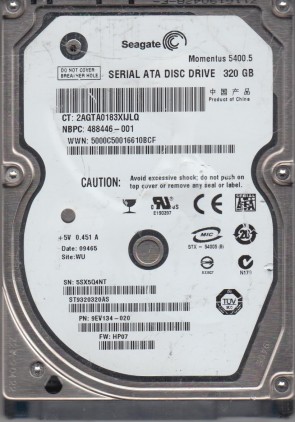
The Seagate ST9320320AS is a 2.5-inch SATA hard disk drive designed primarily for use in older laptops, external enclosures, and budget-friendly data storage applications. Released during the era of 5400 RPM mainstream drives, it filled a role as a cost-effective solution for users who needed moderate storage capacity without demanding high-speed access. Its primary market was entry-level notebooks and secondary storage devices where price per gigabyte was a key concern.
This drive features a spinning speed of 5400 RPM, a SATA 3 Gb/s interface, and an 8 MB cache buffer. Its formatted capacity is 320 GB, which at the time of its release was considered a mid-range volume for portable devices. The physical form factor is standard 2.5-inch, 9.5mm height, making it compatible with most legacy laptops and external drive enclosures. It uses perpendicular recording technology and has an average seek time of approximately 12-13 milliseconds.
In terms of performance, the ST9320320AS delivers sequential read and write speeds typically ranging from 60 MB/s to 80 MB/s under optimal conditions. Random access performance is limited by its 5400 RPM spindle speed and small cache, resulting in noticeable latency when accessing small files or fragmented data. Sustained transfer rates are adequate for sequential workloads like copying large video files but fall short compared to 7200 RPM drives or early solid-state drives.
The primary advantage of this drive is its low cost and reliable mechanical design for its era. It operates relatively quietly with typical acoustic noise levels around 2.4-2.6 bel during idle and seek operations. Power consumption is modest, drawing about 1.5-2.0 watts during read/write and less than 0.5 watts in idle mode, which is beneficial for battery life in older laptops. However, its main disadvantages include sluggish random I/O performance, a higher failure rate compared to modern SSDs after years of use, and a limited capacity that cannot handle today’s operating systems and large software libraries efficiently.
This drive is best suited for non-critical data storage where speed is not a priority, such as media archives, backup drives for older systems, or as a replacement in legacy hardware where compatibility with newer high-speed drives is not possible. It is also acceptable for storing office documents, photos, and music files in a secondary bay. It is not recommended for running modern operating systems, gaming, or any application requiring fast boot times and quick program launches.
For purchase advice, consider the Seagate ST9320320AS only if you have a specific need for a low-cost, low-power drive in a legacy system and cannot use an SSD due to interface or BIOS limitations. If the device supports it, upgrading to a small-capacity SATA SSD, even a 120 GB model, will provide dramatically better responsiveness. If you require this exact model for a repair or replacement, ensure it is sold as tested working, preferably with a short warranty, and verify the drive’s SMART data for signs of wear before purchasing used units.