Reviews of the Seagate ST9500424AS Hard Drive. Seagate ST9500424AS—a storage device that belongs to a specific era and occupies a distinct position in the market. Whether this is a brand-new mainstream drive or a decades-old retro component, our goal remains the same: to evaluate it fairly within its intended context. We will examine its physical specifications, interface compatibility, real-world transfer performance, acoustic behavior, thermal output, and long-term reliability considerations.
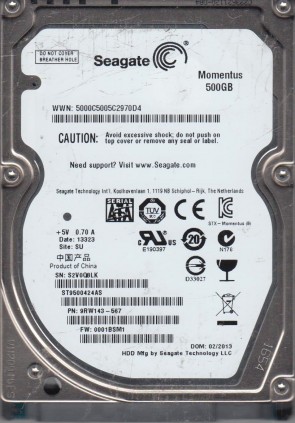
The Seagate ST9500424AS is a 2.5-inch internal hard disk drive designed primarily for laptops and portable external enclosures. It belongs to the Momentus 7200.4 series, positioning it as a performance-oriented storage solution for mobile computing environments. Its core specification includes a 500GB storage capacity, a 7200 RPM spindle speed, a 16MB cache buffer, and a SATA 3.0 Gb/s interface, distinguishing it from slower 5400 RPM alternatives.
In terms of performance benchmarks, the ST9500424AS delivers sequential read and write speeds averaging between 80 MB/s and 100 MB/s, with burst speeds reaching up to 130 MB/s in optimal conditions. Random access times hover around 14 to 16 milliseconds, a respectable figure for a mechanical hard drive in its class. It performs reliably under sustained workloads, maintaining consistent transfer rates without significant throttling, making it capable for moderate file transfers and system booting.
A key advantage of this drive is its 7200 RPM spindle speed, which provides noticeably faster application loading and boot times compared to common 5400 RPM laptop drives. The 500GB capacity remains adequate for storing an operating system, essential applications, and a moderate media library. Additionally, its 2.5-inch form factor and low power consumption (approximately 2.0W idle) make it easy to integrate into most standard laptops without cooling or thermal concerns.
However, the ST9500424AS has notable drawbacks. Its mechanical nature means it is vulnerable to physical shock, impact, and vibration, which can lead to data loss. Noise and heat generation are higher than 5400 RPM counterparts, with audible seek sounds and operating temperatures around 40-45°C under load. The 16MB cache is modest by modern standards, limiting its ability to handle multiple simultaneous read/write requests efficiently.
Performance bottlenecks become apparent in scenarios demanding high random I/O, such as running multiple virtual machines or heavy multitasking. The drive’s SATA 3.0 Gb/s interface also caps its maximum throughput, preventing it from utilizing the full bandwidth of newer SATA 6 Gb/s ports. Consequently, it is not suitable as a primary drive for modern operating systems expecting fast sequential reads for tasks like video editing or large database file handling.
Ideal usage scenarios include upgrading older laptops that still rely on a SATA 3 Gb/s interface, acting as a secondary data storage drive in desktops, or serving as a cost-effective media storage solution for portable devices. It works well as a boot drive for Windows 7 or earlier operating systems, but it is not recommended for Windows 10/11 without an SSD acceleration layer.
For purchasing consideration, the Seagate ST9500424AS is best acquired as a used or refurbished unit due to its discontinued status. Buyers should verify low power-on hours and a healthy SMART status before purchase. Users requiring modern performance should instead consider a SATA SSD or a larger-capacity 5400 RPM HDD. Overall, this drive offers a solid balance of capacity and speed for older laptops but is obsolete for current-generation computing demands.
