Reviews of the Toshiba MK1651GSY Hard Drive. Toshiba MK1651GSY—a storage device that belongs to a specific era and occupies a distinct position in the market. Whether this is a brand-new mainstream drive or a decades-old retro component, our goal remains the same: to evaluate it fairly within its intended context. We will examine its physical specifications, interface compatibility, real-world transfer performance, acoustic behavior, thermal output, and long-term reliability considerations.
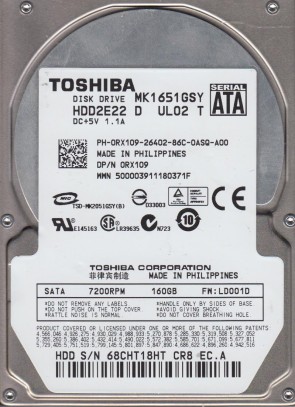
The Toshiba MK1651GSY is a 2.5-inch hard disk drive designed primarily for use in portable external enclosures, older laptops, and specific consumer electronics requiring a reliable magnetic storage solution. Its product positioning targets the value-oriented segment, offering a balance between capacity and cost rather than cutting-edge speed or high durability.
Core specifications include a 160GB storage capacity, a 5400 RPM spindle speed, a SATA 3.0 Gbps interface, and a 16MB cache buffer. The drive features a slim 9.5mm z-height and utilizes perpendicular magnetic recording technology. Its average seek time is rated at approximately 12 milliseconds, and it operates with an acoustic noise level of about 24 dB during idle.
In performance benchmarks, the MK1651GSY achieves sequential read speeds of around 80 MB/s and write speeds near 75 MB/s under optimal conditions. Random access performance is modest, with 4K read operations typically under 1.0 MB/s. For sequential workloads like copying large media files, the drive delivers adequate throughput, but it struggles heavily with heavy multitasking or operating system boot tasks due to the low rotational speed.
Advantages of the Toshiba MK1651GSY include its very low power consumption, drawing under 2.0 watts during read/write operations and less than 0.5 watts in idle, making it suitable for battery-sensitive devices. It also runs cool and nearly silent in use. However, its primary drawback is extremely slow random I/O performance, which makes Windows or macOS feel sluggish during everyday desktop use. Additionally, the 160GB capacity is now considered very small for modern operating systems and user files.
This drive is best suited for secondary storage roles, such as in an external USB enclosure for file backups, storing archived photos, or as a bulk data drive in a home media server for music and videos. It is also acceptable for legacy systems where SATA II support is required and higher speeds are not necessary. It is not recommended for use as a primary OS drive for Windows 10 or later.
For purchase recommendations, the MK1651GSY is only viable if available at a very low price (under $10 USD) for a specific legacy or secondary use case. In nearly all modern applications, a 2.5-inch SSD or a larger capacity 5400 RPM HDD (e.g., 500GB or 1TB) offers significantly better performance and value. Consider an SSD for any system where responsiveness matters, or a newer, higher-capacity HDD for pure bulk storage needs.
