Reviews of the Toshiba MK6475GSX Hard Drive. Toshiba MK6475GSX—a storage device that belongs to a specific era and occupies a distinct position in the market. Whether this is a brand-new mainstream drive or a decades-old retro component, our goal remains the same: to evaluate it fairly within its intended context. We will examine its physical specifications, interface compatibility, real-world transfer performance, acoustic behavior, thermal output, and long-term reliability considerations.
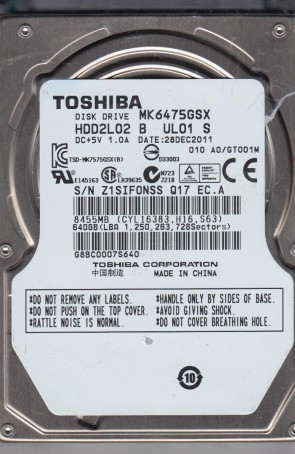
The Toshiba MK6475GSX is a 2.5-inch internal hard disk drive designed primarily for mainstream laptops, external enclosures, and portable storage applications. It utilizes a 5400 RPM spindle speed and a SATA 3.0 Gb/s interface, positioning itself as a cost-effective storage solution rather than a high-performance component. With a storage capacity of 640 GB, it targets users who require moderate data storage without the premium cost of solid-state drives or high-speed mechanical drives.
Core specifications include a 5400 RPM rotation speed, a 16 MB cache buffer, and an average seek time of approximately 12 milliseconds. The drive features a shock sensor technology designed to protect data during accidental drops, and its form factor is standard for most notebook computers. Power consumption is rated at around 1.5 watts during read/write operations and less than 0.5 watts when idle, making it suitable for battery-powered devices.
In terms of performance, the MK6475GSX delivers sequential read and write speeds averaging between 60 MB/s and 80 MB/s under typical operating conditions. This is adequate for everyday tasks such as booting an operating system, launching applications, and transferring moderate-sized files. However, it significantly lags behind 7200 RPM drives and any modern SSD, and random access performance is limited, leading to noticeable delays when multitasking or accessing scattered data.
A primary advantage of this drive is its affordability and reliability for bulk storage. It operates relatively quietly and produces minimal heat, making it a stable choice for users on a strict budget. On the downside, its low rotational speed and small cache size result in sluggish performance compared to faster HDDs or SSDs, and it is not suitable for demanding workloads like video editing or high-frequency database access.
The main drawbacks include a higher likelihood of mechanical failure over time compared to solid-state alternatives and a clear bottleneck in systems requiring fast load times. The drive’s areal density is lower than more modern models, meaning it stores less data per platter, which can impact performance in heavy read/write scenarios. Additionally, it lacks advanced features like SATA 6.0 Gb/s support, which limits its compatibility with newer platforms.
This hard drive is best suited for budget-conscious laptop users, secondary storage in desktops, or as a replacement for older, smaller drives in legacy systems. It also works well in external USB enclosures for backup or media storage where speed is not critical. Users who require rapid boot times, game loading, or professional content creation should consider a SSD instead.
For purchasing, the MK6475GSX is recommended only if the primary goal is low-cost storage and the user does not prioritize performance. It is widely available as a used or refurbished part, and buyers should verify the drive’s condition and warranty before purchase. New alternatives at similar price points often offer better speeds or higher capacities, so comparing current market options is advisable. Overall, it remains a functional but outdated choice for basic storage needs.
