Reviews of the Western Digital WD1600BUDT Hard Drive. Western Digital WD1600BUDT—a storage device that belongs to a specific era and occupies a distinct position in the market. Whether this is a brand-new mainstream drive or a decades-old retro component, our goal remains the same: to evaluate it fairly within its intended context. We will examine its physical specifications, interface compatibility, real-world transfer performance, acoustic behavior, thermal output, and long-term reliability considerations.
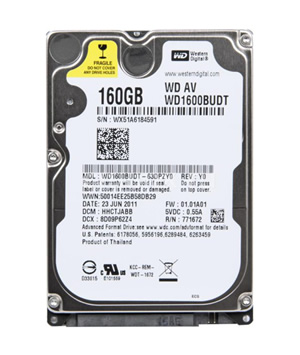
The Western Digital WD1600BUDT is a 160GB, 3.5-inch internal hard drive designed primarily for surveillance and digital video recorder (DVR) applications. It belongs to Western Digital’s Purple series (though notably branded as a BUDT model, which predates the modern Purple naming), targeting continuous, low-power operation in systems requiring 24/7 recording. This drive utilizes a standard SATA 3.0 Gb/s interface and operates at a spindle speed of 5400 RPM, prioritizing reliability and thermal efficiency over raw performance.
Core specifications include a 160GB storage capacity, an 8MB cache buffer, and an average seek time of 8.9 ms. The drive features an integrated vibration protection sensor and a firmware tuned specifically for video streaming workloads, which helps reduce frame loss and ensures stable data capture across multiple camera feeds. Its physical dimensions are standard for 3.5-inch drives, and it weighs approximately 450 grams. Importantly, it is engineered for a 24/7 operational duty cycle, with a workload rating of up to 55 TB per year.
In terms of performance, the WD1600BUDT achieves sequential read speeds of approximately 110 MB/s and sequential write speeds of around 100 MB/s under ideal conditions, which is adequate for standard definition and some mid-resolution surveillance streams. However, its limited cache size and 5400 RPM design mean it falls short compared to modern 7200 RPM drives or SSDs in burst data transfers and random access tasks. Benchmarks suggest it handles up to 8 simultaneous camera streams at 720p without frame drops, but performance degrades with higher-resolution or high-frame-rate recordings.
Primary advantages include its exceptional reliability for continuous usage, with a low failure rate documented in long-term DVR environments. The drive runs cool and quietly, typically generating below 25 dBA during operation, and consumes only about 4 to 5 watts of power, making it suitable for systems with limited cooling. On the downside, its 160GB capacity is very small by modern standards, limiting its usefulness to legacy systems or single-camera setups. Additionally, the SATA 3.0 Gb/s interface is outdated, and the lack of advanced features like TLER or RAID support limits its deployment in enterprise storage arrays.
For typical users, the main weakness is the obsolete capacity and interface, which cannot meet the demands of modern high-definition or multi-channel NVR installations. The drive also lacks a high cache size, resulting in noticeable latency when multiple streams attempt simultaneous writes. Moreover, while designed for surveillance, it does not include Western Digital’s newer AllFrame technology found in modern Purple drives, which further improves stream management and error recovery.
This drive is best suited for upgrading older DVRs that specifically require a 160GB form factor, as a direct replacement for a failed unit, or for low-budget, low-resolution monitoring systems with only one or two cameras. It is also a viable option for embedded industrial systems where reliability and low power draw are prioritized over capacity and speed. It is not recommended for desktop use, gaming, or as an OS drive due to its low performance and specialized firmware.
Purchasing this drive today is challenging as it is discontinued and only available through secondhand markets or surplus dealers. If found new, prices are typically low but may vary significantly. For new installations, buyers should opt for modern surveillance drives (e.g., Western Digital Purple series with at least 1TB capacity) to ensure compatibility, better performance, and longer warranty support. Only consider the WD1600BUDT if strict legacy hardware compatibility is required and lower capacity is acceptable.
In summary, the WD1600BUDT is a reliable but obsolete storage component that performs admirably within its intended niche. Its strengths in continuous operation and low power consumption are overshadowed by insufficient capacity and slow data transfer rates for contemporary applications. While not a universal choice, it remains a functional option for very specific legacy surveillance needs, provided the user accepts its limitations and bargain-bin availability.