Reviews of the Western Digital WD50EFRX Hard Drive. Western Digital WD50EFRX—a storage device that belongs to a specific era and occupies a distinct position in the market. Whether this is a brand-new mainstream drive or a decades-old retro component, our goal remains the same: to evaluate it fairly within its intended context. We will examine its physical specifications, interface compatibility, real-world transfer performance, acoustic behavior, thermal output, and long-term reliability considerations.
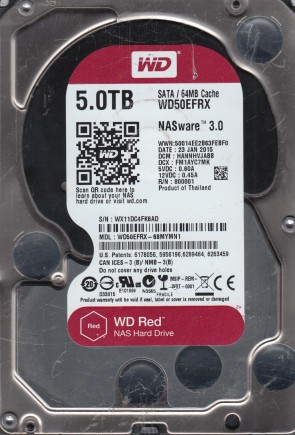
The Western Digital WD50EFRX is a 5TB hard drive from the WD Red series, specifically designed for entry-level to mid-range Network Attached Storage (NAS) environments. It is engineered for systems with up to 8 bays, prioritizing reliability and power efficiency over raw speed. Its primary target is users who need a cost-effective, high-capacity storage solution for 24/7 operation in a multi-drive setup.
Core specifications include a 5400 RPM spindle speed, 64MB cache, and a SATA 6Gb/s interface. The drive utilizes Conventional Magnetic Recording (CMR) technology, which avoids the performance and reliability complexities often associated with SMR (Shingled Magnetic Recording) drives in RAID arrays. Form factor is standard 3.5-inch, with an average power consumption of around 4.3W during operation.
In terms of performance, the WD50EFRX delivers sequential read/write speeds of approximately 150-170 MB/s under optimal conditions. This is adequate for file storage, media streaming, and backup tasks, but it is not suitable for high-intensity workloads like database servers or virtualization. Random access times are moderate, reflecting its 5400 RPM design, which prioritizes low noise and heat output over latency.
Key advantages include high reliability and robustness in RAID environments due to CMR technology, low power consumption, and quiet operation. The drive also includes NASware 3.0 firmware, which optimizes RAID error recovery and reduces drive dropouts. A notable disadvantage is its relatively slow transfer speeds compared to 7200 RPM or SSD alternatives, making it not ideal for demanding applications.
Other drawbacks include a higher price per terabyte compared to desktop-class drives, though this is offset by NAS-specific features. Additionally, the 5TB capacity is smaller than modern 8TB to 22TB models, potentially limiting scalability for those with growing storage needs. However, for users with limited capacity requirements, it remains a balanced choice.
This drive is best suited for home media servers, small business NAS units for file sharing and backup, and security camera storage. It excels in environments where data integrity, low noise, and continuous operation are critical. It is not recommended for high-performance computing, game storage, or applications requiring fast random I/O.
For purchase advice, the WD50EFRX is a solid option if you need a dependable 5TB drive for a dedicated NAS system. Ensure compatibility with your NAS enclosure, as modern high-capacity drives are increasingly available. If budget allows, consider newer WD Red Plus models with higher capacities for future growth, but for a specific 5TB requirement, this drive remains a reliable workhorse.
