Reviews of the Western Digital WD64AA Hard Drive. Western Digital WD64AA—a storage device that belongs to a specific era and occupies a distinct position in the market. Whether this is a brand-new mainstream drive or a decades-old retro component, our goal remains the same: to evaluate it fairly within its intended context. We will examine its physical specifications, interface compatibility, real-world transfer performance, acoustic behavior, thermal output, and long-term reliability considerations.
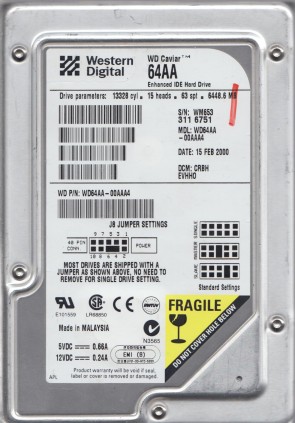
The Western Digital WD64AA is a 6.4 GB hard disk drive from the early 2000s, targeting mainstream desktop PCs and entry-level storage needs. It utilizes an IDE (Parallel ATA) interface with a 5400 RPM spindle speed, positioning it as a budget-friendly option for basic computing tasks and archival purposes rather than high-performance or modern applications.
Core specifications include a 6.4 GB formatted capacity, a 2 MB buffer cache, and an Ultra ATA/100 interface supporting up to 100 MB/s burst transfer rates. The drive features a single-platter design, which helps reduce power consumption and noise compared to multi-platter alternatives of its era, with an average seek time of approximately 9.5 ms and a rotational latency of 5.6 ms.
In terms of performance, sequential read speeds typically max out around 25-35 MB/s under ideal conditions, while write speeds are slightly lower. Random access performance is limited by the 5400 RPM spindle and small cache, making it noticeably slower than contemporary 7200 RPM drives like the WD Caviar series. However, for its generation, it offered acceptable throughput for loading small applications and transferring modest file sizes.
Advantages of the WD64AA include very low operating noise, minimal heat output, and excellent power efficiency by early-2000s standards, making it suitable for silent or low-power builds. Its IDE interface ensures broad compatibility with older motherboards and legacy systems. The single-platter construction also contributes to mechanical reliability in non-intensive usage scenarios.
Disadvantages are significant by modern metrics: the 6.4 GB capacity is insufficient for operating systems beyond Windows XP or basic Linux distributions, and the IDE interface is obsolete on current hardware without adapters. Performance is far below even entry-level SSDs or modern HDDs, with sluggish random I/O that severely hampers multitasking and boot times. The drive is also prone to bottlenecks when handling multiple concurrent requests.
Ideal use cases include retro computing projects, restoring vintage PCs from the Pentium III or early Athlon era, or serving as a secondary or tertiary storage device for period-correct applications and data. It can also function as a boot drive for lightweight, single-tasking operating systems like DOS or Windows 98 where speed is not critical.
Purchasing recommendations are highly conditional. For hobbyists seeking authentic parts for a vintage system, a working WD64AA can be a functional choice, but buyers should verify it has been tested and has low power-on hours. For any practical modern use, a low-capacity SATA SSD with an IDE adapter offers vastly superior reliability and speed at a lower overall cost. Given its age and limited capacity, this drive is best viewed as a collector’s item or emergency replacement rather than a daily driver.
Overall, the Western Digital WD64AA is a competent relic of its time, delivering quiet and decent performance for basic tasks within its narrow niche. While it is obsolete for contemporary computing, properly preserved units remain useful for keeping legacy systems operational and maintaining historical digital archives.