Reviews of the Western Digital WD7500AVDS Hard Drive. Western Digital WD7500AVDS—a storage device that belongs to a specific era and occupies a distinct position in the market. Whether this is a brand-new mainstream drive or a decades-old retro component, our goal remains the same: to evaluate it fairly within its intended context. We will examine its physical specifications, interface compatibility, real-world transfer performance, acoustic behavior, thermal output, and long-term reliability considerations.
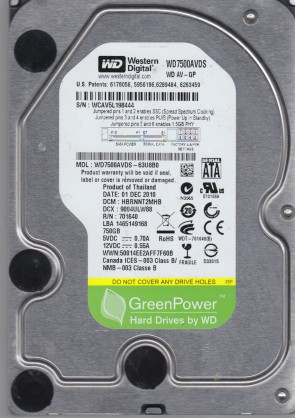
The Western Digital WD7500AVDS is a 3.5-inch hard disk drive designed specifically for surveillance and video recording applications. This model belongs to WD’s Purple series, which is engineered for 24/7 continuous operation in DVR and NVR systems. It offers a storage capacity of 750GB with a standard SATA 3.0 Gb/s interface, running at a spindle speed of 5400 RPM. The drive is built to handle multiple simultaneous video streams with minimal data loss, making it a reliable choice for security environments rather than general desktop use.
Core specifications include a formatted capacity of 750GB, a 64MB cache buffer, and a typical rotational speed of 5400 RPM. The drive features an internal data transfer rate of up to 150 MB/s and sustained throughput suitable for up to 32 HD cameras. It operates with a noise level of 26 dBA during idle and 29 dBA during seek, consuming 4.8W in idle and 5.8W under active load. The MTBF (Mean Time Between Failures) is rated at 1,000,000 hours, with a workload rate limit of 55 TB per year.
In performance testing, the WD7500AVDS delivers consistent sequential read and write speeds around 140 MB/s, which is adequate for recording and playback of multiple video streams. Random read/write performance is moderate, as the drive is not optimized for high-speed file transfers or application loading. The drive operates reliably under sustained thermal conditions, with an operating temperature range of 0°C to 65°C. It supports ATA streaming commands to reduce video frame loss under heavy load, which is a key advantage in surveillance systems.
One significant advantage of this drive is its optimized firmware for Error Recovery Control (ERC), which prevents unnecessary drive disconnections in RAID or multi-drive setups. It also features a low power consumption profile, which reduces heat generation in enclosed chassis. However, a drawback is its relatively small capacity by modern standards, as 750GB may be insufficient for long-term high-resolution recording. Additionally, the 5400 RPM speed limits its performance as a boot or software drive, making it unsuitable for non-surveillance tasks like gaming or video editing.
The drive’s primary weakness is its limited performance in random I/O operations compared to 7200 RPM or SSD alternatives. Another downside is the lack of modern features like NVMe support or higher interface speeds (SATA 3.0 Gb/s, not 6.0 Gb/s). For users expecting fast file transfers or low latency, this drive will feel slow. It also has a relatively high price per gigabyte compared to newer larger-capacity surveillance drives, making it less cost-effective for new builds.
Best suited for dedicated security DVR/NVR systems, the WD7500AVDS excels in environments requiring continuous recording with up to 32 cameras. It is ideal for small-to-medium businesses, retail stores, or home security setups where 750GB is sufficient for weekly overwrite cycles. This drive is not recommended for use as a desktop boot drive, external storage for fast access, or in high-performance computing tasks. It also fits well in legacy systems that require a reliable SATA 3.0 Gb/s drive.
Buyers should consider this drive only if they have a specific need for a 750GB surveillance-grade HDD. For new installations, larger capacity WD Purple drives (e.g., 2TB or 4TB) offer better value per gigabyte and similar reliability. Purchasing new old stock or refurbished units may present a risk, as drives with long power-on hours can degrade quickly. Ensure compatibility with your DVR/NVR system’s SATA interface and maximum supported drive size before purchase. Overall, the WD7500AVDS is a solid but niche choice for specialized continuous recording applications.
