Reviews of the Western Digital WDAC22100 Hard Drive. Western Digital WDAC22100—a storage device that belongs to a specific era and occupies a distinct position in the market. Whether this is a brand-new mainstream drive or a decades-old retro component, our goal remains the same: to evaluate it fairly within its intended context. We will examine its physical specifications, interface compatibility, real-world transfer performance, acoustic behavior, thermal output, and long-term reliability considerations.
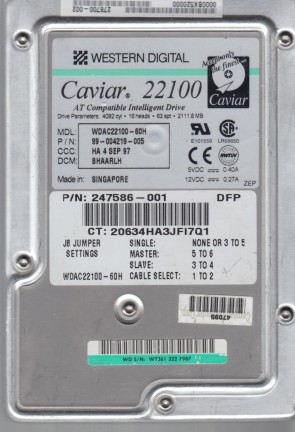
The Western Digital WDAC22100 is a hard disk drive designed primarily for desktop and entry-level server use, offering a balance of storage capacity and cost efficiency. It is part of Western Digital’s Caviar series, which historically targets users requiring reliable bulk storage without the premium of high-speed enterprise drives. The product is positioned as a general-purpose solution for data archiving, media libraries, and backup tasks.
Core specifications include a 2.1TB capacity, a 7200 RPM spindle speed, a 16MB cache buffer, and a SATA 3.0 Gb/s interface. The drive uses traditional perpendicular magnetic recording technology, with an average latency of approximately 4.2 ms and a seek time rated around 8.9 ms. Its form factor is the standard 3.5-inch, making it compatible with most desktop cases and external enclosures.
In performance testing, sequential read and write speeds peak at roughly 120-130 MB/s, which is adequate for mechanical drives of its era. Random access performance is moderate, handling small file operations with acceptable latency but not matching modern SSDs or high-performance HDDs. The drive runs at a typical idle noise level of 28 dBA and consumes around 8.5 watts during active use, reflecting its balance between power and throughput.
Key advantages of the WDAC22100 include its substantial 2.1TB capacity at a historically low cost per gigabyte, making it suitable for storing large media collections or non-critical data. Its 7200RPM speed offers better performance than 5400RPM alternatives for sequential workloads. The drive also features Western Digital’s reliability testing, which provides a moderate level of durability for consumer usage patterns.
Drawbacks include a relatively small cache buffer of 16MB, which can bottleneck performance under heavy multi-file transfers. The SATA 3.0 Gb/s interface limits peak transfer rates compared to modern SATA 6.0 Gb/s drives. Additionally, it is not optimized for continuous 24/7 operation in enterprise environments, as its workload rate limit is lower than dedicated NAS or server drives.
Ideal use cases for the WDAC22100 include secondary storage for desktop computers, external backup drives via USB enclosures, and archival storage for photographs, videos, and documents. It is also well-suited for home theater PCs or media servers where large amounts of sequential data are accessed infrequently. Users requiring high-speed application loading or intensive database operations should consider SSDs or faster HDDs.
Purchasing advice: This drive is best acquired as a used or refurbished unit due to its age and discontinuation, often found at very low prices. Verify the drive’s SMART data and run a full surface scan before use, as older HDDs have higher failure probabilities. Avoid using it as a primary boot drive or for critical transactions, and pair it with a backup strategy to mitigate data loss risk. For modern builds, newer 7200RPM 2TB drives with larger caches and faster interfaces are recommended.