Reviews of the Seagate ST360020A Hard Drive. Seagate ST360020A—a storage device that belongs to a specific era and occupies a distinct position in the market. Whether this is a brand-new mainstream drive or a decades-old retro component, our goal remains the same: to evaluate it fairly within its intended context. We will examine its physical specifications, interface compatibility, real-world transfer performance, acoustic behavior, thermal output, and long-term reliability considerations.
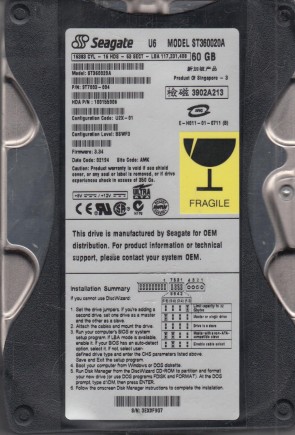
The Seagate ST360020A is a classic hard disk drive from the late 1990s, designed for desktop Personal Computer storage. It represents an earlier generation of ATA/IDE interface drives, targeted at consumers needing basic data storage for operating systems, applications, and personal files. Its core purpose is providing affordable magnetic storage for legacy systems, lacking the speeds or capacities of modern solid-state drives.
This drive has a formatted capacity of 6.4 GB, a spindle speed of 5400 RPM, and an internal transfer rate of around 85 MB/s. It features an Ultra ATA/66 interface, offering a burst transfer rate of 66.6 MB/s. The average seek time is approximately 9.5 milliseconds, with a 512 KB buffer size. These are the defining specifications that dictate its performance.
In real-world usage, the ST360020A delivers adequate performance for Windows 98 or early Windows XP installations. Sequential read and write speeds peak around 20 MB/s to 30 MB/s, sufficient for loading software and booting older operating systems. However, random access times are slow by modern standards, resulting in noticeable delays when multitasking or opening fragmented files. It operates with moderate noise, producing a distinct seek sound typical of era drives.
Key advantages of this drive include its robust mechanical reliability for its time and compatibility with a wide range of motherboards from the late 90s. Its 6.4 GB capacity is sufficient for basic office documents and period-specific applications. A major drawback is its low capacity and slow sequential speeds, making it unsuitable for modern high-bandwidth tasks like 4K video editing or fast system booting. It also generates more heat than contemporary drives.
This hard drive is best suited for retro computing enthusiasts maintaining or restoring vintage PCs, such as those with Intel Pentium II or III processors. It functions adequately for period-correct software, retro gaming, or as a secondary archival drive for old projects. It is not appropriate for use as a primary drive in any modern computer due to interface and speed limitations.
For purchasing advice, the ST360020A is now a collector or replacement item. If sourced from the secondary market, ensure it has been tested for bad sectors and shows low power-on hours. Prices are typically low, but consider that compact flash to IDE adapters or even very small modern SSDs with IDE interfaces offer better reliability and speed for retro builds. Only buy this for authentic vintage hardware restoration where compatibility is paramount.