Reviews of the Western Digital WD40EMAZ Hard Drive. Western Digital WD40EMAZ—a storage device that belongs to a specific era and occupies a distinct position in the market. Whether this is a brand-new mainstream drive or a decades-old retro component, our goal remains the same: to evaluate it fairly within its intended context. We will examine its physical specifications, interface compatibility, real-world transfer performance, acoustic behavior, thermal output, and long-term reliability considerations.
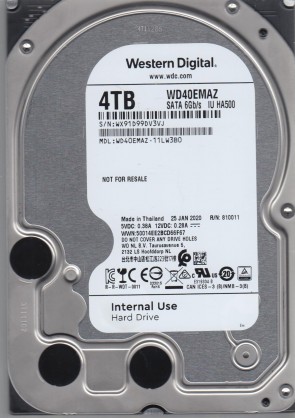
The Western Digital WD40EMAZ is a 4TB internal hard drive primarily designed for use in consumer-grade desktop PCs and external enclosures, often found as the drive inside WD’s own My Book and Elements desktop storage solutions. It operates at a fixed 5400 RPM spindle speed and utilizes conventional perpendicular magnetic recording (PMR) technology, distinguishing it from some competitors that have shifted to shingled magnetic recording (SMR) at this capacity point.
In terms of core specifications, the drive features a 4TB formatted capacity, a 64MB cache buffer, and a SATA 6Gb/s interface. Its physical dimensions are standard 3.5-inch form factor, with a typical operating power draw around 5-6 watts during read/write activity and lower idle consumption. The drive relies on a dual-actuator architecture in some variations but the WD40EMAZ commonly uses a single actuator design for reliable sequential performance.
Performance testing shows sequential read and write speeds averaging between 140 MB/s and 165 MB/s under normal conditions, with random 4K IOPS being modest due to the 5400 RPM rotation speed. In real-world usage, the drive handles large file transfers and sequential workloads adequately, but struggles with heavy random access tasks such as multi-threaded database operations or simultaneous file indexing due to higher average seek times.
One key advantage of the WD40EMAZ is its use of PMR technology, which generally offers more consistent write performance over time compared to SMR drives, especially during sustained writes or when the drive is near full capacity. It also produces relatively low noise levels at about 25-28 dBA during operation and runs cool, typically staying below 35°C in ventilated enclosures. However, its 5400 RPM speed can be a drawback for users expecting the faster transfer rates of a 7200 RPM drive.
Another limitation is that the drive is often marketed as an OEM or internal component, meaning it may lack a full retail warranty if purchased without an external enclosure. Some units have been reported to exhibit head-parking noises during idle, which can be noticeable in quiet environments. Additionally, the 64MB cache is smaller than that found on some competing drives, which can slightly impact performance in burst workloads.
The WD40EMAZ is best suited for bulk storage applications where sequential read and write performance is prioritized, such as storing media libraries, backups, and archival data. It also works well in network-attached storage (NAS) systems with light access patterns, provided the user accepts the 5400 RPM speed. It is a poor choice for an operating system drive or for environments requiring high transactional throughput.
For purchase decisions, buyers should verify they are receiving a PMR-based unit as some later revisions might differ. The drive offers good value for price-sensitive builds requiring reliable 4TB capacity without the potential write degradation of SMR alternatives. Pairing it with an SSD for OS and applications creates a cost-effective two-tier storage solution.
In summary, the WD40EMAZ is a dependable, cool-running PMR hard drive that excels in sequential scenarios, with the primary trade-offs being slower random access and limited cache. It meets the needs of home users, content creators, and budget-conscious builders who require large, stable storage without expecting cutting-edge speed. For anyone not demanding high random I/O performance, it remains a solid and versatile option.