Reviews of the Seagate ST2000NM0054 Hard Drive. Seagate ST2000NM0054—a storage device that belongs to a specific era and occupies a distinct position in the market. Whether this is a brand-new mainstream drive or a decades-old retro component, our goal remains the same: to evaluate it fairly within its intended context. We will examine its physical specifications, interface compatibility, real-world transfer performance, acoustic behavior, thermal output, and long-term reliability considerations.
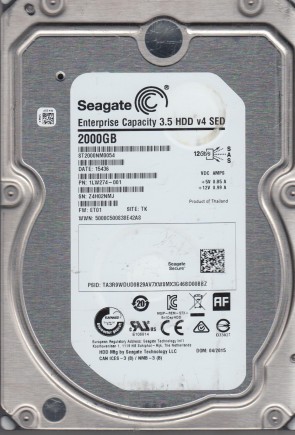
The Seagate ST2000NM0054 is an enterprise-grade hard disk drive designed for high-capacity storage in data centers and business servers. Part of the Exos 7E2000 series, this 2TB drive utilizes traditional CMR (Conventional Magnetic Recording) technology and a 7200 RPM spindle speed, positioning it as a reliable workhorse for sequential workloads such as bulk data archiving and video surveillance.
Core specifications include a SATA 6Gb/s interface, 256MB cache buffer, and a form factor of 3.5 inches. It features a sustained data transfer rate of up to 215 MB/s, an average latency of 4.16 ms, and a rated workload of 550 TB per year. The drive is equipped with Seagate’s PowerChoice technology for idle power management and supports RAID environments.
In performance benchmarks, the ST2000NM0054 delivers consistent read and write speeds around 200–210 MB/s under sequential workloads, with random access times averaging 12 ms for reads and 14 ms for writes. It handles mixed workloads adequately for its class, though it naturally cannot compete with SSD speeds for random I/O tasks. Power consumption is moderate at approximately 5.7W during operation and 3.6W at idle.
Primary advantages of this drive include its high reliability rating of 2 million hours MTBF (Mean Time Between Failures) and a 5-year limited warranty, which underscores its enterprise targeting. The CMR technology ensures consistent performance in write-heavy applications without the performance degradation seen in SMR drives. Additionally, it operates relatively quietly for a 7200 RPM enterprise drive, with acoustic levels around 2.8 to 3.6 bels.
On the downside, the ST2000NM0054 offers only 2TB capacity, which is modest compared to modern 20TB-plus enterprise drives, leading to worse storage density. Its price per terabyte is also higher than consumer drives or larger enterprise models. Additionally, while it performs well for sequential workloads, random access performance is limited by its mechanical nature, making it unsuitable for transactional databases or active virtualization.
This drive is best suited for environments requiring durable, high-reliability storage for cold data, backup repositories, network-attached storage (NAS) arrays, and surveillance systems where sequential write patterns dominate. It is also a valid choice for system integrators building cost-effective RAID arrays for file servers that do not demand high random I/O performance.
For purchase decisions, consider the ST2000NM0054 if your priority is long-term reliability and predictable performance in a 24/7 operation, and if your capacity needs fit under 2TB per drive. If higher capacity or better random performance is required, consider newer Exos X series HDDs or enterprise SSDs. However, for its specific niche as a durable, CMR-based 2TB workhorse, this drive remains a solid, professional-grade option.
