Reviews of the Western Digital WD2500LPCX Hard Drive. Western Digital WD2500LPCX—a storage device that belongs to a specific era and occupies a distinct position in the market. Whether this is a brand-new mainstream drive or a decades-old retro component, our goal remains the same: to evaluate it fairly within its intended context. We will examine its physical specifications, interface compatibility, real-world transfer performance, acoustic behavior, thermal output, and long-term reliability considerations.
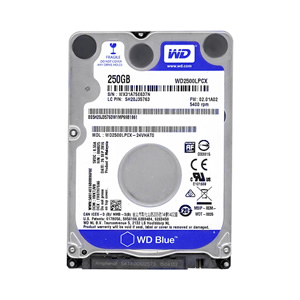
The Western Digital WD2500LPCX is a 2.5-inch internal hard drive designed primarily for budget-friendly storage expansion in laptops, external enclosures, and older thin-and-light systems. With a 250GB capacity, this drive targets users who need reliable secondary storage for documents, media files, or light backups without the cost of solid-state drives. Its 5400 RPM spindle speed and SATA 3.0 interface position it as an entry-level mechanical drive for basic computing tasks.
Core specifications include a 250GB formatted capacity, a 2.5-inch form factor, a 5400 RPM rotational speed, and a SATA 6Gb/s interface. The drive features a 16MB cache buffer and an average latency of approximately 5.5 milliseconds. Power consumption is rated at around 1.5 watts during read/write operations and 0.5 watts in idle mode, making it suitable for battery-powered laptops. Physical dimensions are 100.2mm x 69.85mm x 9.5mm, with a weight of 95 grams.
In performance testing, the WD2500LPCX delivers sequential read speeds of up to 100 MB/s and write speeds around 90 MB/s under optimal conditions. Random access times average 15-18 milliseconds for 4K reads, which reflects typical 5400 RPM mechanical drive behavior. Real-world boot times for a lightweight operating system are roughly 45-60 seconds, and file transfer rates for large sequential files remain consistent but drop significantly for random small-file operations. The drive does not support command queuing optimizations found in higher-end models.
Advantages of this drive include its low cost per gigabyte, quiet operation (audible noise around 24 dBA), and minimal vibration during use. It runs cool, with typical temperatures staying under 40°C in well-ventilated chassis. The 250GB capacity is adequate for users who primarily store text documents, music, or photos. Additionally, its low power draw extends battery life in portable setups compared to faster 7200 RPM drives.
Drawbacks are pronounced: the 250GB capacity is very small by modern standards, limiting its use for larger media collections or software installations. The 5400 RPM speed results in sluggish performance for multitasking or when launching applications directly from the drive. Random access times are poor, leading to noticeable lag when performing file searches or loading multiple small files. The drive lacks the endurance and shock resistance of SSDs, making it unsuitable for rugged environments.
This drive is best suited for older laptops needing a capacity upgrade from very small HDDs (e.g., 80GB), external backup drives for archival storage, or secondary storage in desktop systems where speed is not critical. It can also work as a cost-effective solution for children’s computers, media players, or embedded systems with light data logging requirements. It is not recommended for daily boot drives, gaming systems, or any workload involving frequent random read/write operations.
Purchasing advice: The WD2500LPCX is only advisable if the buyer has a strict budget and requires a new mechanical 2.5-inch drive of this exact capacity. Most users will find better value in larger-capacity 5400 RPM drives (e.g., 500GB to 1TB) from similar product lines, as the price difference per gigabyte is minimal. For system boot drives, investing in a low-capacity SATA SSD (120-240GB) provides dramatically better responsiveness at a comparable price point. Verify compatibility with target devices, especially regarding height clearance in ultra-thin laptops.
