Reviews of the Seagate ST980815A Hard Drive. Seagate ST980815A—a storage device that belongs to a specific era and occupies a distinct position in the market. Whether this is a brand-new mainstream drive or a decades-old retro component, our goal remains the same: to evaluate it fairly within its intended context. We will examine its physical specifications, interface compatibility, real-world transfer performance, acoustic behavior, thermal output, and long-term reliability considerations.
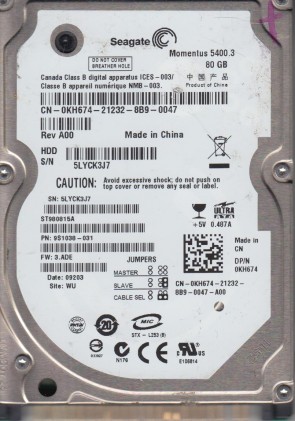
The Seagate ST980815A is a 2.5-inch Parallel ATA (PATA) hard disk drive designed primarily for legacy laptop computers and portable storage devices from the early to mid-2000s. With a storage capacity of 80 GB, it was positioned as a mid-range upgrade for users needing more space than the common 40 GB or 60 GB drives of its era, targeting consumers who required reliable mass storage for everyday computing tasks without the premium cost of high-speed or high-capacity alternatives.
Core specifications include a spindle speed of 5,400 RPM, an 8 MB buffer, and an Ultra ATA/100 interface, which provides a maximum data transfer rate of 100 MB/s. The drive has a form factor of 9.5 mm thickness, making it compatible with most standard laptop bays of the time. It utilizes perpendicular recording technology, which was relatively advanced for its generation, contributing to improved areal density and overall reliability compared to older longitudinal recording drives.
Performance-wise, the ST980815A delivers typical results for a 5,400 RPM PATA drive, with sequential read speeds averaging around 40 MB/s to 50 MB/s and access times in the range of 13 to 15 milliseconds. It is not a speed demon by modern standards, but it was adequate for booting operating systems like Windows XP or early Windows 7, loading office applications, and managing moderate file transfers. In sustained write operations, the drive exhibits consistent throughput without significant throttling, though random read/write performance is notably limited by the PATA bus and mechanical design.
One of the primary advantages of this drive is its robust build quality and relatively low power consumption, which helped extend battery life in compatible laptops. It also generates minimal noise and vibration during operation, making it suitable for quiet environments. However, its main drawbacks include the obsolete PATA interface, which severely limits compatibility with modern systems, and the modest 80 GB capacity that is insufficient for contemporary multimedia or large software libraries. Additionally, the 5,400 RPM speed results in noticeably slower load times compared to later 7,200 RPM drives or solid-state drives.
Given its technical limitations, the ST980815A is best suited for niche retro computing projects, such as restoring vintage laptops, upgrading old industrial equipment that relies on PATA storage, or as a temporary boot drive for testing legacy hardware. It is not recommended for primary use in any modern computer due to interface incompatibility and performance constraints. Users seeking a reliable replacement for a failed drive in a classic system will find it acceptable, but those needing fast or large storage should consider an SSD with a PATA-to-SATA adapter instead.
For purchasing decisions, availability of new old stock (NOS) is limited, and most units on the secondary market are used with unknown wear levels. Buyers should verify the drive’s S.M.A.R.T. health status and confirm compatibility with their specific laptop or device model before purchase. Pricing is typically low, ranging from $10 to $30, reflecting its collector or hobbyist value rather than functional performance. It is generally a safe option for preserving a vintage machine but not a cost-effective upgrade for daily use.
In summary, the Seagate ST980815A is a competent but outdated PATA hard drive that fulfills its intended role in legacy systems. While it offers decent reliability and adequate speed for early 2000s workloads, its small capacity and obsolete interface render it impractical for modern tasks. Its purchase should be limited to specific preservation or repair scenarios where a direct PATA replacement is mandatory. For any other use, modern storage solutions are overwhelmingly superior in speed, capacity, and compatibility.