Reviews of the Seagate ST9146803SS Hard Drive. Seagate ST9146803SS—a storage device that belongs to a specific era and occupies a distinct position in the market. Whether this is a brand-new mainstream drive or a decades-old retro component, our goal remains the same: to evaluate it fairly within its intended context. We will examine its physical specifications, interface compatibility, real-world transfer performance, acoustic behavior, thermal output, and long-term reliability considerations.
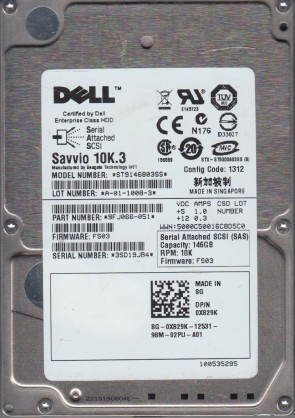
The Seagate ST9146803SS is a 2.5-inch enterprise-grade SAS hard disk drive, primarily designed for use in servers, storage arrays, and mission-critical data centers. It is not aimed at consumer desktop or laptop upgrades, instead serving as a reliable component for high-availability environments requiring consistent performance and robust error correction.
Core specifications include a 146 GB storage capacity, a spindle speed of 15,000 RPM (15K), a 3.0 Gbps SAS interface (SAS 2.0 compatible), and a 16 MB cache buffer. The drive features a 2.5-inch form factor but uses a 15mm z-height, which is thicker than standard 9.5mm laptop drives, ensuring it fits enterprise server bays. Average latency is listed at 2.0 ms, with a sustained data transfer rate up to 122 MB/s.
Performance wise, the 15K RPM delivers very low random access times, typically around 3.5 ms read and 4.0 ms write, making it excellent for transactional workloads such as database logging or high-frequency trading. Sequential read speeds hover near 120 MB/s, while sequential write speeds are slightly lower at approximately 110 MB/s. In RAID configurations, these drives maintain consistent throughput under heavy load, though they cannot match the random IOPS of modern SSDs.
Strengths of the ST9146803SS include extreme reliability, with a Mean Time Between Failures (MTBF) rating of 1.6 million hours, and robust vibration tolerance due to its enterprise design. The SAS interface supports dual-port connectivity, enabling failover and higher data integrity. It also operates relatively cool for a 15K drive, though active cooling in a server chassis is still recommended.
Weaknesses are notable: the 146 GB capacity is very small by today’s standards, and the 15mm thickness limits its physical compatibility. Power consumption is higher than 10K RPM or 7200 RPM drives, drawing around 7-8 watts during operation and 2 watts idle. The biggest drawback is its cost per gigabyte, which is significantly higher than SATA or even older SSDs, making it uneconomical for bulk storage.
This drive excels in legacy enterprise environments where SAS backplanes are already deployed and where latency sensitivity outweighs capacity needs. Use cases include small-footprint database servers, boot drives for hypervisors, or cache tiering in hybrid storage systems. It is not suitable for media libraries, backup archives, or any consumer NAS.
Purchasing advice: only consider this drive if you have an existing SAS infrastructure and require the highest possible HDD random IO performance without migrating to flash. For new deployments, opt for enterprise SSDs like the Seagate Nytro series for better speed and capacity per watt. If budget is a constraint, a 10K RPM SAS drive like the ST9300603SS offers better capacity with slightly lower latency trade-offs. Always verify your host bus adapter compatibility and ensure server bays support 15mm drives.