Reviews of the Seagate ST38002ACE Hard Drive. Seagate ST38002ACE—a storage device that belongs to a specific era and occupies a distinct position in the market. Whether this is a brand-new mainstream drive or a decades-old retro component, our goal remains the same: to evaluate it fairly within its intended context. We will examine its physical specifications, interface compatibility, real-world transfer performance, acoustic behavior, thermal output, and long-term reliability considerations.
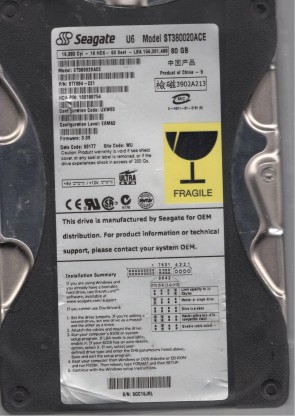
The Seagate ST38002ACE is an internal 3.5-inch hard disk drive originally designed for desktop and entry-level server storage applications from the early 2000s era. It features a parallel ATA (IDE) interface with a spindle speed of 7,200 RPM, offering a native capacity of 80 GB. This model is part of Seagate’s Barracuda ATA V family, with a standard 2 MB buffer and a data transfer rate up to 100 MB/s over the Ultra ATA/100 bus.
Core specifications include a formatted capacity of 80 GB, a seek time of 8.2 ms average read, and a sustained data rate of approximately 44 MB/s. The drive uses a single platter and a lightweight actuator for reduced power consumption, typically drawing around 7.0 W during read/write operations. Its physical dimensions measure 26.1 mm in height, 101.6 mm in width, and 146.99 mm in depth, weighing about 600 grams.
In terms of performance, the ST38002ACE delivers adequate sequential read and write speeds for its generation, with maximum burst rates hitting the Ultra ATA/100 limit under ideal conditions. Real-world file transfers average between 35 and 45 MB/s, which is competitive for a drive from its release period. Random access times are decent but lag behind modern SSDs or even later SATA-based HDDs, with 4K random operations measuring around 0.5 IOPS due to the mechanical nature.
Key advantages include high reliability for its time, with a reported mean time between failures (MTBF) of 600,000 hours, and quiet operation due to Fluid Dynamic Bearing (FDB) motor technology. It also supports Self-Monitoring, Analysis, and Reporting Technology (S.M.A.R.T.) for proactive health monitoring. However, notable drawbacks include a significantly limited capacity by today’s standards, a slower interface compared to SATA, and higher power consumption relative to newer 2.5-inch drives.
This drive is best suited for legacy system restoration, retro PC builds, or as a secondary storage device in older desktop computers that still rely on the IDE interface. It can also serve as a backup solution for small archival data sets where speed is not a priority. It is not recommended for modern operating systems or applications requiring high throughput, such as video editing or gaming.
For purchasing, the ST38002ACE is now primarily found in used or refurbished condition through online auction sites or specialty vintage hardware retailers. Prices vary widely based on condition and seller, typically ranging from $10 to $30. Buyers should verify function and check S.M.A.R.T. data before purchase, as age and use can significantly impact remaining lifespan. Those seeking a more reliable alternative for vintage systems may consider newer SSDs with IDE adapters.