Reviews of the Seagate ST14000NE0008 Hard Drive. Seagate ST14000NE0008—a storage device that belongs to a specific era and occupies a distinct position in the market. Whether this is a brand-new mainstream drive or a decades-old retro component, our goal remains the same: to evaluate it fairly within its intended context. We will examine its physical specifications, interface compatibility, real-world transfer performance, acoustic behavior, thermal output, and long-term reliability considerations.
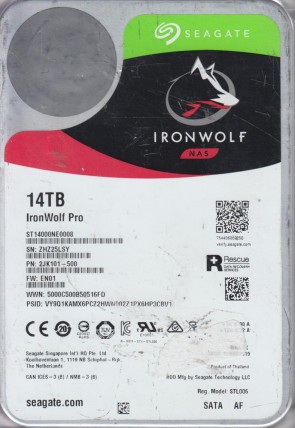
The Seagate ST14000NE0008 is a 14TB 3.5-inch enterprise-class hard disk drive from the Exos 7E10 series, designed for high-capacity data center and NAS environments. It utilizes conventional magnetic recording (CMR) technology rather than shingled magnetic recording (SMR), ensuring consistent write performance and data integrity. The drive is targeted at cloud storage, archival systems, and heavy-duty RAID deployments where reliability per terabyte is critical.
Core specifications include a 7200 RPM spindle speed, 256MB cache buffer, and a SATA 6Gb/s interface. The drive features a helium-sealed design to reduce friction and power consumption, with a rated workload limit of 550TB per year. It offers an average latency of 4.16ms and a sustained transfer rate up to 249MB/s, enabling competitive sequential throughput for bulk storage tasks.
In performance benchmarks, the ST14000NE0008 delivers strong sequential read speeds around 270MB/s and write speeds near 260MB/s under ideal conditions. Random access times for 4K operations are slower, typical for large-capacity HDDs, with read IOPS around 150 and write IOPS around 300. The drive maintains consistent performance under sustained load, though it can exhibit higher vibration in multi-drive arrays without proper dampening.
Key advantages include excellent power efficiency per terabyte, drawing approximately 5.0W idle and 7.8W during active operation, along with a five-year limited warranty. The CMR technology avoids the write amplification issues found in SMR drives, making it suitable for write-heavy workflows. Disadvantages include higher acoustic noise levels (about 2.8 bel) compared to 5400 RPM drives, and a price per terabyte that may be slightly higher than consumer-class models.
Primary suitability extends to enterprise backup servers, video surveillance storage, cold data archives, and network-attached storage (NAS) systems requiring high capacity and reliability. It also performs well in large-scale object storage and cloud infrastructure where power and cooling costs are a concern. The drive is not recommended for desktop gaming, virtual machine boot drives, or environments demanding rapid random access.
For purchase decisions, evaluate total cost of ownership including power and cooling rather than upfront cost alone. The ST14000NE0008 is a solid choice for building dense storage arrays if continuous write integrity and long-term reliability are paramount. Avoid this drive if low noise or maximum random read performance is required, or if the workload regularly exceeds the annualized workload rate. Pair with enterprise-grade RAID controllers and vibration-dampened chassis for optimal lifespan.