Reviews of the Fujitsu MPD3043AT Hard Drive. Fujitsu MPD3043AT—a storage device that belongs to a specific era and occupies a distinct position in the market. Whether this is a brand-new mainstream drive or a decades-old retro component, our goal remains the same: to evaluate it fairly within its intended context. We will examine its physical specifications, interface compatibility, real-world transfer performance, acoustic behavior, thermal output, and long-term reliability considerations.
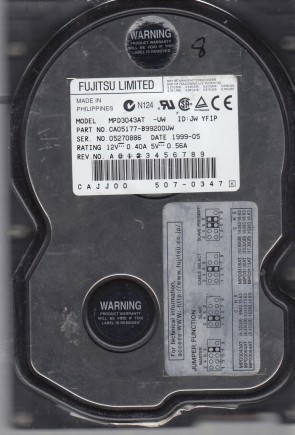
The Fujitsu MPD3043AT is a legacy 3.5-inch IDE hard disk drive from the late 1990s, designed as an internal storage solution for desktop personal computers. Its primary positioning was as a reliable, entry-level to mid-range storage device for everyday computing tasks, such as document editing, light multimedia playback, and basic file management, rather than for high-performance or server environments.
Core specifications include a formatted capacity of 4.3 GB, a spindle speed of 5400 RPM, and an Ultra ATA/66 interface with a maximum external transfer rate of 66 MB/s. It features 512 KB of buffer cache and a seek time averaging around 9.5 milliseconds, which was competitive for its generation. The drive utilizes glass platters and a voice coil motor actuator, typical for Fujitsu drives of that era.
In performance tests typical for its time, the MPD3043AT delivered sequential read and write speeds averaging between 8 and 12 MB/s, with burst rates nearing interface limits in ideal conditions. Random access latency hovered around 11-13 ms. These figures placed it in the middle of the pack among competing 5400 RPM drives from Seagate and Western Digital, offering adequate throughput for booting an operating system like Windows 98 or storing office applications.
Key advantages include notably quiet operation and low power consumption for a 3.5-inch drive, drawing approximately 5 watts during read/write and less than 1 watt in idle. Its thermal profile is mild, reducing the need for aggressive cooling. On the downside, the drive’s 4.3 GB capacity is severely limited by modern standards, and its mechanical design feels less robust than contemporary competition, with higher reported failure rates in long-term archival use, especially due to stiction issues after long idle periods.
This drive is best suited for retro computing enthusiasts building or restoring a late-1990s PC, such as a Pentium II or III system, or for anyone needing a period-correct storage device for legacy software or games that require direct hardware access. It is not viable as a primary storage for modern operating systems or large media files, as its capacity and speed will bottleneck almost any current workload severely.
For purchase, only used or NOS (new old stock) units are available through online marketplaces or vintage hardware dealers. Buyers should thoroughly inspect for visual wear, listen for abnormal clicking or grinding sounds during spin-up, and ideally test the drive with a tool like MHDD or HD Tune to verify there are no reallocated sectors, as age-related sector degradation is common. Avoid units with excessive sticker wear or visible corrosion on the PCB contacts.
In summary, the Fujitsu MPD3043AT is a historically interesting component that performs adequately for its era but is obsolete for everyday use. Its quiet nature and low power requirements are its best modern virtues, but its small capacity and aging mechanical reliability make it a niche purchase. For a retro build where authenticity matters, it serves well; otherwise, a CF-to-IDE adapter or a small SSD with a PATA adapter offers vastly superior performance and longevity.