Reviews of the Hitachi HTE541660J9AT00 Hard Drive. Hitachi HTE541660J9AT00—a storage device that belongs to a specific era and occupies a distinct position in the market. Whether this is a brand-new mainstream drive or a decades-old retro component, our goal remains the same: to evaluate it fairly within its intended context. We will examine its physical specifications, interface compatibility, real-world transfer performance, acoustic behavior, thermal output, and long-term reliability considerations.
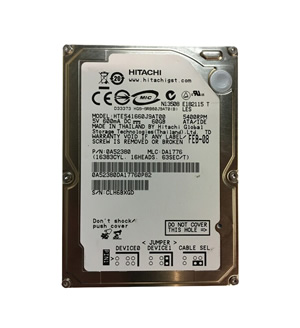
The Hitachi HTE541660J9AT00 is a 2.5-inch hard disk drive designed primarily for use in laptops and portable external storage enclosures. It targets users who require reliable mass storage at a low cost per gigabyte, positioning itself as a budget-friendly alternative to solid-state drives for bulk data storage rather than operating system boot drives.
Core specifications include a 5400 RPM spindle speed, a 16 MB cache buffer, and a SATA 3.0 Gbps interface with a standard 9.5 mm z-height. Typical capacities for this series range from 160 GB to 500 GB, making it suitable for users with modest storage needs such as document archiving, media libraries, and secondary backup drives. The drive uses perpendicular magnetic recording technology.
In terms of performance, sequential read and write speeds average around 80-90 MB/s under ideal conditions, with random access times typically between 12-15 milliseconds. These figures are consistent with other 5400 RPM drives of its generation. It handles large sequential file transfers adequately but struggles with heavy multitasking or random I/O operations due to the mechanical latency and limited cache.
A key advantage of this model is its low power consumption, drawing about 1.5-2 watts during active use and significantly less when idle, which contributes to longer battery life in laptops. The drive also operates quietly, producing noise levels around 23 dBA. However, its main drawback is slow performance for booting operating systems or launching applications compared to any modern SSD. Additionally, physical shock resistance is limited, making it vulnerable to data loss if dropped during operation.
This drive excels in scenarios where large amounts of data need to be stored inexpensively and accessed sequentially, such as media jukeboxes, file archival, or as a backup destination. It is also viable for older laptops where upgrading the OS to an SSD is not planned, or for use in network-attached storage devices that prioritize capacity over speed. It is not recommended for gaming, video editing, or as a primary system disk.
For purchasing decisions, this drive is best acquired as new-old-stock or from budget retailers given its age and the prevalence of higher-capacity alternatives. Buyers should verify compatibility with their device’s thickness constraints, as some ultrabooks require 7 mm drives. If budget permits, a 2.5-inch SATA SSD offers vastly superior performance for a modest price premium, making this HDD a niche choice solely for pure storage volume at minimal cost. Overall, it delivers reliable, straightforward storage for low-expectation workloads.