Reviews of the Hitachi HTE721060G9AT00 Hard Drive. Hitachi HTE721060G9AT00—a storage device that belongs to a specific era and occupies a distinct position in the market. Whether this is a brand-new mainstream drive or a decades-old retro component, our goal remains the same: to evaluate it fairly within its intended context. We will examine its physical specifications, interface compatibility, real-world transfer performance, acoustic behavior, thermal output, and long-term reliability considerations.
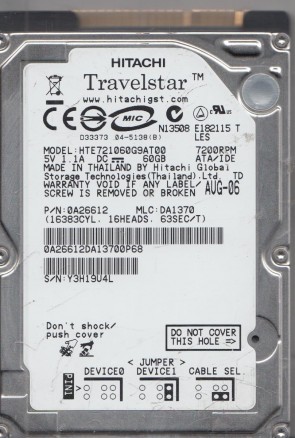
The Hitachi HTE721060G9AT00 is a 2.5-inch SATA hard disk drive designed for mainstream laptop and portable storage applications. It offers a storage capacity of 60 GB and operates at a rotational speed of 7200 RPM, positioning it as a higher-performance option in the era of thin mechanical drives. The drive features a 16 MB cache buffer and utilizes a standard SATA 3 Gb/s interface, making it compatible with a wide range of older laptops and external enclosures.
Core specifications include a formatted capacity of 60 GB, an average seek time of approximately 10.5 ms, and a data transfer rate of up to 100 MB/s. The drive has a physical footprint of 9.5 mm in height, which fits most standard laptop bays. Its power consumption is relatively moderate, drawing around 2.0 watts during read/write operations and 0.8 watts when idle, which is typical for a 7200 RPM 2.5-inch drive of its generation.
In terms of performance, the HTE721060G9AT00 delivers sequential read speeds averaging 80-90 MB/s and write speeds around 70-80 MB/s under optimal conditions, which was competitive for its time. Random access performance is adequate for basic multitasking, with 4K random read operations reaching about 0.8 MB/s. The drive’s 7200 RPM spindle speed gives it a noticeable advantage over 5400 RPM counterparts in sustained file transfers and boot times, though it still lags far behind modern SSDs.
Strengths of this drive include its reliable mechanical design and robust build quality, which were characteristic of Hitachi’s (later HGST) manufacturing. It operates relatively quietly with acoustic levels around 2.7 bel idle and 3.0 bel seek. Additionally, it supports advanced power management features for laptop use. However, the drive has notable weaknesses: its 60 GB capacity is very limited by modern standards, and its shock tolerance (300 G operating, 900 G non-operating) is low compared to newer drives.
The primary drawback is its age; as a product from the late 2000s, it suffers from low storage density and slow random I/O performance, making it unsuitable for operating systems beyond Windows 7 era without significant lag. Furthermore, its SATA 3 Gb/s interface is obsolete, and the drive lacks native Advanced Format (4K sector) support, which can cause alignment issues with modern operating systems if not properly managed.
This drive is best suited for legacy system upgrades, retro computing projects, or as a low-cost secondary storage device for non-critical data in older laptops. It can also be used in external USB enclosures for basic file backups, provided the user accepts its limited speed and capacity. It is not recommended for use as a primary boot drive in any modern computer due to its performance bottleneck.
For purchasing, this model is now only available on the used or refurbished market, typically priced very low. Buyers should verify its health via S.M.A.R.T. data and ensure it has no bad sectors before use. Given the minimal cost, it can be a functional option for hobbyists, but most users are better served by a low-cost SATA SSD of similar price, which provides vastly superior performance and reliability.
